

Designing Brand Identity: A Complete Guide to Building a Strong & Memorable Brand
Designing Brand Identity: A Complete Guide to Building a Strong & Memorable Brand
In a world where consumers are bombarded with thousands of marketing messages every day, how does a business move from being just another “option” to being a “destination”? The answer lies in the strategic process of designing brand identity.
Far more than just a logo or a catchy slogan, your identity is the soul of your business. It is the visual, emotional, and psychological blueprint that tells the world who you are, what you stand for, and why they should care.
What is Brand Identity?

At its core, brand identity is the collection of all elements that a company creates to portray the right image to its consumer. Many businesses seek out a professional brand design agency to ensure this “face” of the business is both professional and cohesive.
While people often confuse terms, there is a distinct difference between branding and brand identity:
1. The Brand:
The emotional relationship between the customers and the business.
The emotional relationship between the customers and the business.
2. Branding:
The active process of shaping that perception through various branding opportunities.
The active process of shaping that perception through various branding opportunities.
3. Brand Identity:
The tangible expressions (visuals, voice, and values) that result from brand identity development.
The tangible expressions (visuals, voice, and values) that result from brand identity development.
Why a Strong Brand Identity Matters
Building a cohesive identity isn’t just an aesthetic choice; it’s a strategic one. When you build a brand identity that resonates, you unlock several competitive advantages:
1. Build Trust and Credibility:
A professional visual brand identity signals that you are an expert in your field.
A professional visual brand identity signals that you are an expert in your field.
2. Command Higher Prices:
Strong brands are perceived as higher quality, allowing for premium pricing.
Strong brands are perceived as higher quality, allowing for premium pricing.
3. Ensure Consistency:
It provides a “north star” for your brand identity and marketing efforts.
It provides a “north star” for your brand identity and marketing efforts.
4. Foster Loyalty:
Customers don’t just buy products; they buy into identities that reflect their own values.
Customers don’t just buy products; they buy into identities that reflect their own values.
The 5-Step Roadmap to Creating Brand Identity
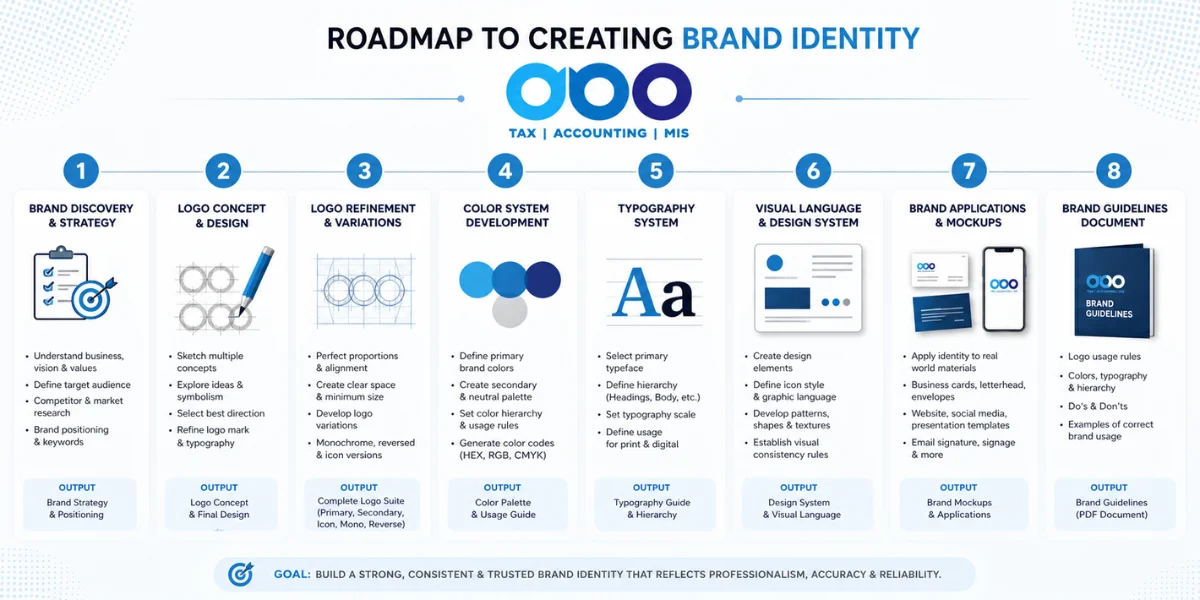
Creating brand identity is a transformative journey that turns a business concept into a living, breathing personality. It’s not just about aesthetics; it’s about strategic storytelling. By following a structured brand identity development process from deep-dive research and the brand identity prism to creative brand identity design you ensure your business doesn’t just show up, but stands out. Here are the five essential stages to building a cohesive, professional, and truly unforgettable presence in your market.
Step 1: Laying the Foundation (Research & Strategy)
You cannot start creating brand identity visuals until you understand the “substance.” This stage is often referred to as the discovery phase in brand identity solutions.
The Brand Identity Prism
To get a 360-degree view of your brand, many experts use the brand identity prism. This model looks at six aspects: Physique, Personality, Culture, Relationship, Reflection, and Self-image. It helps ensure that your brand identity and logo design aren’t just pretty, but deeply rooted in your company’s DNA.
Define Your Purpose and Mission
Why does your business exist? Your mission statement should be the heartbeat of your identity. If you are looking for a deep dive into this philosophy, the Designing Brand Identity book by Alina Wheeler is considered the “bible” for many designers and CEOs alike.
Step 2: Developing the Visual Elements
This is where the magic of creative brand identity design happens. These components are the tools you use to communicate your personality at a glance.
1. Typography
Fonts carry immense psychological weight.
1. Serif fonts feel traditional and trustworthy.
2. Sans-serif fonts feel modern and approachable.
2. Color Palette
Color is the most immediate way to trigger emotion. A professional brand design agency will select colors based on psychological triggers like blue for trust or red for energy to ensure your visual brand identity is impactful.
3. Logo Brand Identity
Your logo is the cornerstone of your brand, but it is not the whole brand. Logo brand identity refers to how your mark functions across different environments. A great logo is:
1. Simple:
Easily recognizable.
Easily recognizable.
2. Scalable:
Looks good on a billboard and a favicon.
Looks good on a billboard and a favicon.
Step 3: Crafting Your Brand Voice
If your brand were a person, how would it speak? The “voice” is the personality of your written and spoken communication.
Brand Persona | Tone of Voice | Example |
The Expert | Authoritative, precise, calm | Mercedes-Benz |
The Friend | Casual, humorous, relatable | Old Spice |
The Visionary | Inspiring, bold, futuristic | Tesla |
Consistency in voice is what makes a brand feel “real.” If your website is formal but your Instagram is full of slang, it creates a “brand dissonance” that confuses customers.
Step 4: The Brand Style Guide
Once you have completed your brand identity development, you must codify it. A Brand Style Guide is a rulebook that ensures everyone from your social media manager to your third-party printers stays on brand.
Comprehensive brand identity solutions include:
1. Logo usage (clearance space, minimum size).
2. Color codes (HEX, RGB, CMYK).
3. Typography hierarchy (H1, H2, body text).
4. Visual brand identity standards for photography and icons.
Step 5: Implementing Identity Across Touchpoints
A brand identity is only as strong as its execution. You need to roll it out across every channel where your customers interact with you. This intersection of brand identity and marketing is where your ROI is realized.
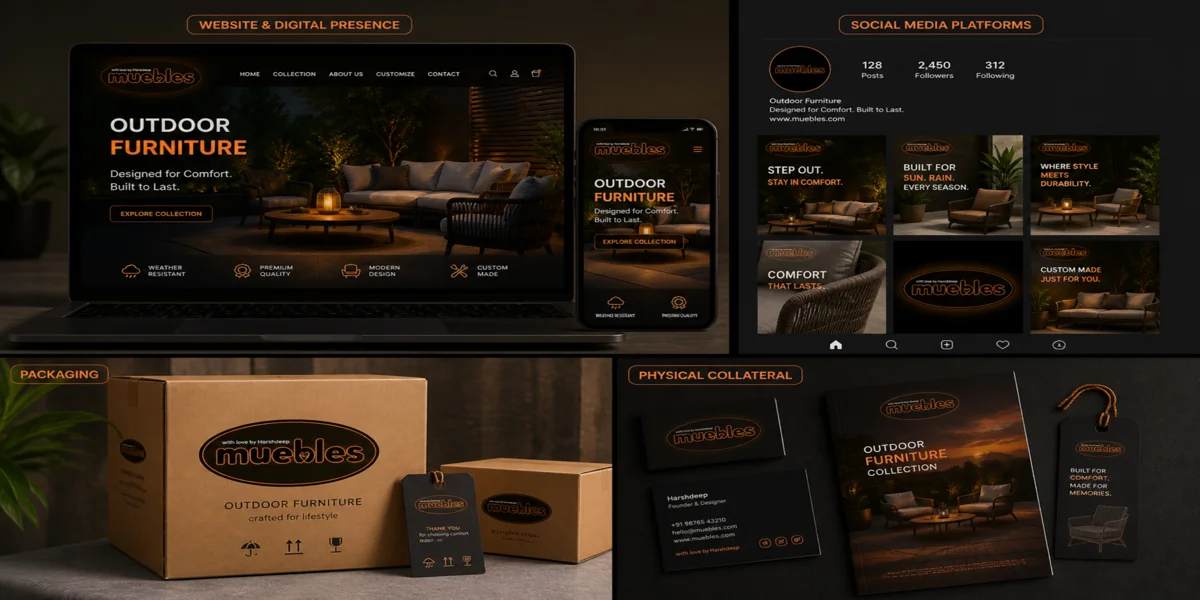
Website and Digital Presence
Your website is your digital flagship store. It should utilize your color palette and typography seamlessly to guide the user through their journey. Ensure your UI/UX design reflects your brand values if you’re a “simple” brand, your website navigation should be effortless.
Digital and Social Media
Your website is your digital flagship store. It should utilize your brand identity design to guide the user journey. Every post on Instagram or LinkedIn is one of many branding opportunities to reinforce your visual style and voice.
Packaging and Physical Collateral
For physical products, the unboxing experience is a massive part of creative brand identity design. The weight of the paper and the texture of the box are tangible touchpoints that prove your brand’s quality.
Common Pitfalls While Building A Brand Identity
1. Chasing Trends:
Trends fade. Aim for a timeless visual brand identity.
Trends fade. Aim for a timeless visual brand identity.
2. Lack of Internal Alignment:
If your employees don’t understand your brand identity development, they can’t represent the brand to customers.
If your employees don’t understand your brand identity development, they can’t represent the brand to customers.
3. Inconsistency:
Using different versions of a logo brand identity across platforms kills consumer trust.
Using different versions of a logo brand identity across platforms kills consumer trust.
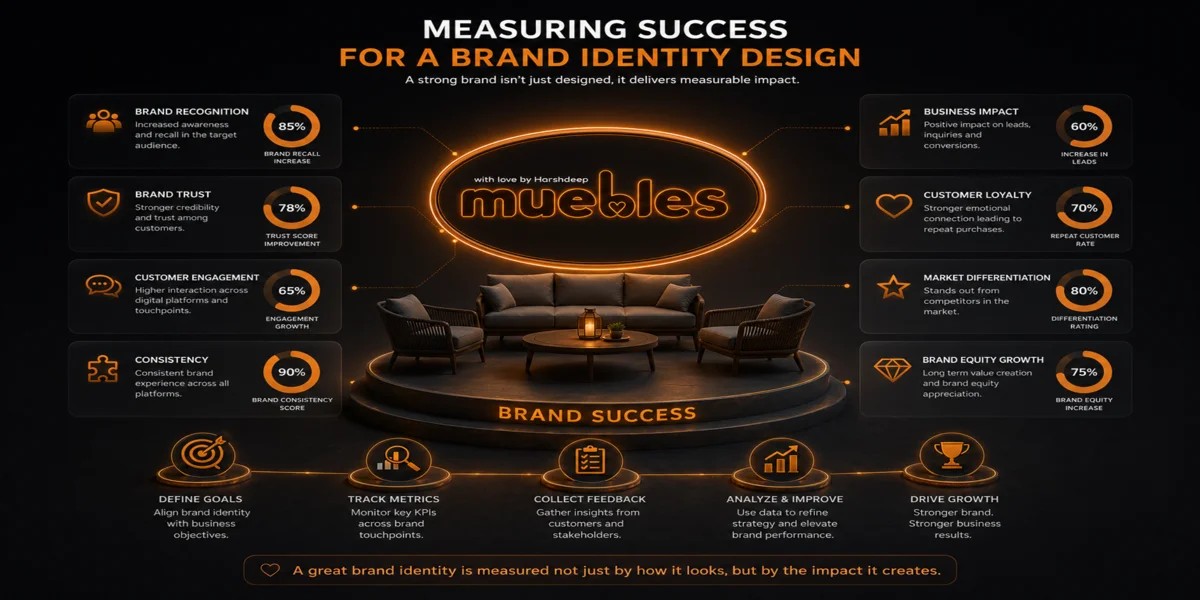
Measuring Success For a Brand Identity Design
How do you know if your efforts in designing brand identity are working?
1. Brand Recognition:
Can people identify your brand without seeing the name?
Can people identify your brand without seeing the name?
2. Consistency:
Does your brand identity and marketing feel like it’s coming from one single source?
Does your brand identity and marketing feel like it’s coming from one single source?
3. Equity:
Is your brand name alone helping you convert leads?
Is your brand name alone helping you convert leads?
Conclusion
Designing brand identity is not a “one and done” task. It is a living, breathing asset that evolves as your business grows. By combining the strategic depth of the brand identity prism with creative brand identity design, you create more than just a company you create a legacy.
Whether you work with a brand design agency or use the Designing Brand Identity book as your guide, the goal remains the same: to build a brand that is as unforgettable as it is authentic.
FAQ's
While many models exist, the most common are Visual Design (Logo, Color), Voice (Messaging, Tone), and Values (The Mission/Core Beliefs).
Start with research. Define your audience and mission before you touch brand identity and logo design.
These are the strategic and creative services provided by designers or agencies to help a business build a brand identity from the ground up, including logo design, color palettes, and voice guidelines.
While often used interchangeably, they represent different layers of a business. Branding is the overarching emotional and strategic process of building a reputation. Brand identity is the collection of tangible, visual elements such as the logo, color palette, typography, and imagery that represent the brand and communicate those values to the audience.
A brand design agency provides the expertise needed to translate a business’s core values into a cohesive visual language. Partnering with professionals ensures:
- Consistency: Uniformity across all digital and physical touchpoints.
- Market Differentiation: A unique visual identity that stands out from competitors.
- Strategic Growth: Design systems that can scale as the company evolves.
- Objectivity: Fresh, expert perspectives on how the market perceives your brand.
Successful creative brand identity design goes beyond a logo. It includes:
- Logo Suite: Primary, secondary, and sub-mark versions.
- Color Theory: A palette that evokes the desired emotional response.
- Typography: Fonts that reflect the brand’s personality (e.g., modern, traditional, or bold).
- Brand Voice: The tone used in all written communication.
- Style Guide: A comprehensive document ensuring all assets remain on-brand.
Finding branding opportunities involves looking for gaps where the current brand experience doesn’t meet customer expectations. Common opportunities include:
- Rebranding or Refreshing: Updating an outdated look to appeal to a younger demographic.
- Brand Extensions: Entering new product categories with a consistent sub-brand.
- Digital Transformation: Optimizing the brand for social media, mobile apps, and UX.
- Content Strategy: Leveraging storytelling to build deeper community connections.
A professional designing brand identity workflow typically follows these four stages:
- Discovery: Researching the target audience, competitors, and brand mission.
- Strategy: Defining the brand’s unique value proposition and “personality.”
- Design: Iterating on visual concepts, logos, and collateral.
- Implementation: Launching the identity and providing guidelines for long-term consistency.


