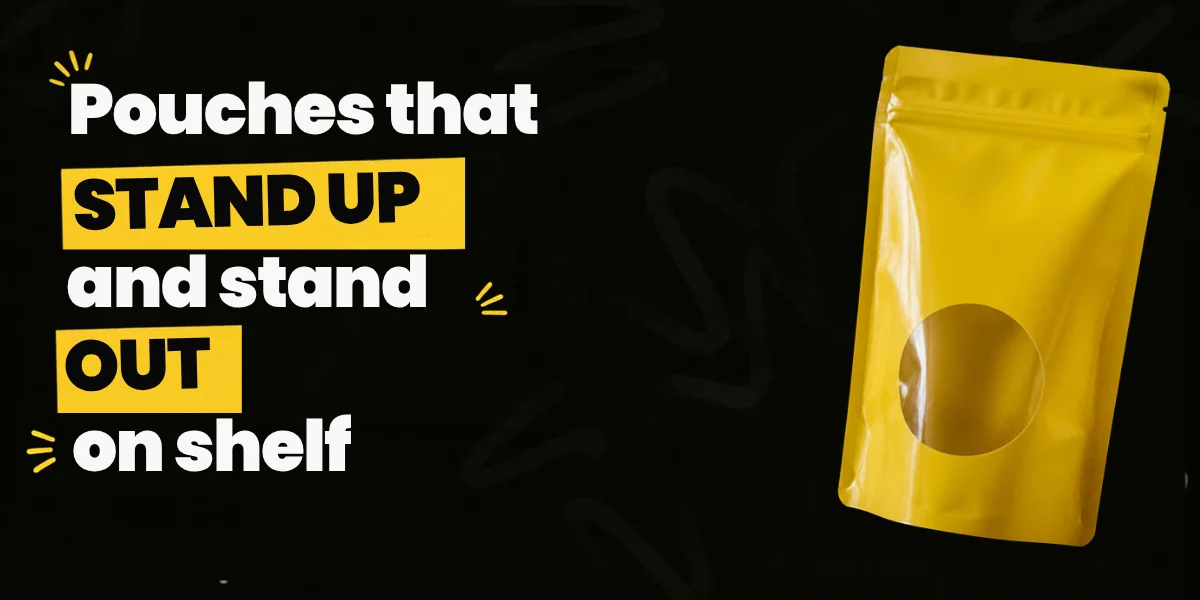
Pouch packaging design looks easy until the first printed sample arrives. A Kolkata dry-fruit brand approves a handsome front panel on screen, and then the real pouch comes back with the logo sliced by the zip, the flavour name lost in a fold and the barcode printing across a seal. The design was fine. It just wasn’t designed for a pouch.
A pouch is soft, it bends, it gets sealed, filled and squeezed. The artwork has to live with all of that. That is why pouch design needs its own rules, and why the same layout that works on a box can fail on a film.
This guide covers what pouch packaging design is, which pouch to pick, six tips for the front of the pack, how to prepare artwork for print, what to ask a printer and the mistakes that cost the most. No jargon, no design degree needed.
What Is Pouch Packaging Design?
Pouch packaging design is the planning of how a flexible pouch looks, works and sells: its shape, its printed artwork, its zip or spout, its colours and the information it carries. It is design for a soft, sealed pack rather than a hard box or jar.
Most pouches are made from layers of thin film. The artwork is printed on that film, the pouch is formed, filled and sealed, and then it travels, sits on a shelf and gets opened at home. Each of those stages affects how the design should be built.
A good pouch design answers three things at once. It has to look good on a shelf. It has to work for the machine that fills it. And it has to be easy for a person to open, pour and close. Miss one and the pack suffers.

Pouches are common for snacks, spices, coffee, tea, grains, dry fruit, pet food, powders and liquids with spouts. If you want the basics of how pouches are used in food, the guide on food pouch design is a good start.
FAQs: What Is Pouch Packaging Design?
What is a pouch in packaging?
A pouch is a flexible pack made from layers of film, sealed on its edges. It can stand, lie flat or hang, and often has a zip or spout.
What products are sold in pouches?
Snacks, spices, tea, coffee, grains, dry fruit, sauces, powders, pet food and many household products.
Is pouch design different from box design?
Yes. A pouch bends, folds and has seals, so the layout must work around those areas. A box is rigid and flat on each side.
What kind of pouch packaging work does Brij Design Studio do?
Brij Design Studio designs packaging for brands, pouches included, and prepares print-ready files so the artwork suits the real pack.
Why Does Pouch Packaging Design Matter for Food and Snack Brands?
Pouch packaging design matters because a pouch is often the entire advert. On a peg hook or in a quick-commerce thumbnail, nothing else is there to explain the product.
Look at a Chennai general store. Pouches of spice, rice flour and snack mixes hang in rows under bright lights. A shopper’s eye moves quickly along them. The ones that read clearly, with a strong lead colour and a short product name, get picked up. The crowded ones blur into the wall.
Pouch design also affects how the product is used at home. A zip that opens cleanly and a pouch that stands up in a cupboard make people buy again. A pouch that tears badly or spills does the opposite, and that memory sticks.

A few other reasons it matters:
- Pouches are light and cheap to ship, so many new food brands start with them. That makes the design the main difference between them.
- Flexible film takes full-colour print, so brands have lots of freedom, and lots of ways to overdo it.
- A range of flavours needs a system. Pouches that look like cousins help a brand own its shelf space.
FAQs: Why Pouch Design Matters
Do customers judge a product by its pouch?
Very often. If the pouch looks careful and clear, people assume the product inside is too.
Why are so many new food brands choosing pouches?
They suit small and mid-sized runs, they are light to transport and they hold a lot of print and information on a small surface.
Can a pouch look premium?
Yes. Matt film, restrained colours, clean type and good print quality can make a pouch feel as upmarket as a jar or box.
Which kinds of products has Brij Design Studio designed packs for?
Its case studies include food, dairy and confectionery packs. The case studies page shows the projects.
Which Type of Pouch Should You Choose?
Choose the pouch type by how the product is filled, stored and used. A stand-up pouch suits shelves, a flat pouch suits small portions, and a spouted pouch suits liquids and pastes.
- Stand-up pouch: has a bottom fold that lets it stand. Common for snacks, tea and dry fruit. See the full guide on stand-up pouch packaging design.
- Flat or pillow pouch: sealed on three or four sides. Suits sachets, single servings and light snacks.
- Side-gusset pouch: expands at the sides, often used for coffee and bulk goods.
- Spouted pouch: has a small nozzle. Used for sauces, juices, purees and liquid products.
Before settling on one, check the filling method with the pack maker. Some machines handle certain shapes better, and changing it late is expensive. The post on pouch designing adds more detail on the shapes.
FAQs: Choosing a Pouch Type
Which pouch is best for snacks?
Stand-up pouches with a zip are popular for snacks, as they sit well on shelves and can be resealed. Flat pouches work for small single-serve packs.
Which pouch is best for liquids?
A spouted pouch, since the nozzle lets the liquid pour without a mess.
Do I need a zip on my pouch?
If people will use the product more than once, yes. For single-use sachets it is not needed.
Can Brij Design Studio design for any pouch type?
The studio designs packaging across formats. The right pouch type is decided together with the product, the filling method and the brand’s plans.
How to Design Pouch Packaging: 6 Practical Tips
To design pouch packaging well, keep the front simple, lead with one colour, show the product honestly, plan for the zip and seals, put key information in order and test a printed sample. Here are the six tips in detail.
1One Clear Message on the Front
The brand name, the product name and one short promise. Everything else moves to the back or the sides.
2One Lead Colour
Choose a colour that is easy to spot on the shelf, then use the rest of the palette to tell flavours or variants apart.
3Show the Real Product
A window, a clear photo or an honest illustration. People trust what they can see.
4Plan Around Zips, Seals and Folds
Keep logos and text away from heat seals, the zip and the bottom fold, or they will be cut, squashed or hidden.
5Order the Information
Weight, ingredients, legal text and barcode need a clear home, so the front stays calm and the back stays useful.
6Test a Printed Sample
Fill one, fold it, stand it up and photograph it from a distance. A pouch looks different once it has product inside.

How Should You Plan the Front of a Pouch?
Plan the front as a small poster that has to work from a metre away. A big brand name, a clear product name and one focal visual are usually enough. The rest is support.
Leave breathing room. Pouches are curved once filled, so edges disappear into the roundness. Crowded fronts lose their edges first.
What Should Never Sit Near the Seals and Fold Lines?
Logos, flavour names, barcodes and legal text should stay clear of the side and top seals, the zip line and the base fold. These areas get pressed, crimped or hidden when the pouch is formed and filled. A safe margin around them keeps the important content readable. For choosing readable type for a small, curved surface, the guide to fonts for packaging helps.
FAQs: Pouch Design Tips
How many colours should a pouch use?
As few as the brand needs. One lead colour plus one or two supporting ones is usually enough for a clear front.
Should I add a window to my pouch?
If the product looks appealing, yes. A window builds trust, especially for dry fruit, nuts and grains. It is less useful for powders.
Matt or gloss: which finish is better for pouches?
Matt feels calm and premium, and gloss feels bright and lively. Pick the one that matches the brand, then check how it looks under shop lights.
How does Brij Design Studio plan a pouch so seals and folds don’t spoil the design?
The studio prepares print-ready files in-house, so the layout is built around the real pouch outline from the start and not squeezed in at the end.
How Do You Prepare Pouch Artwork for Print?
You prepare pouch artwork by working on the flat pack outline from the pack maker, keeping text inside the safe area, extending colours past the cut line and checking a proof before the full run. Skipping these steps is the quickest way to a reprint.

- Get the flat outline (the dieline) from the pack maker. Never guess the size.
- Extend background colours past the cut line, so a small shift in cutting doesn’t leave white edges.
- Keep key text and logos inside the safe area, away from seals and the zip.
- Leave a clean space for the barcode, with enough contrast to scan.
- Ask for a proof or a test print, and check colours under normal daylight.
Colours on film often print a little differently from on-screen colours. Ask the printer how they handle colour matching, especially for brand colours that must stay consistent across flavours.
FAQs: Pouch Artwork and Print
What is a dieline?
It is the flat outline of the pack showing the cut lines, seals, folds and safe areas. Artwork is built on top of it.
What is bleed?
It is the extra artwork past the cut line. It stops thin white edges appearing if the cutting shifts slightly.
Why do colours look different on a pouch than on my screen?
Screens use light and print uses ink on film. The film’s finish and layers also change how colours look. A printed proof shows the real result.
Can Brij Design Studio prepare print-ready pouch files?
Yes. The studio’s work runs from strategy to print-ready files, all handled in-house.
What Should You Ask a Pouch Printer Before You Start?
Ask the printer about the film structure, the print method, the minimum order, the proof process and how the pouch will be sealed. Their answers shape the design before a single line is drawn.
- “Which film layers do you recommend for this product, and how long does the product need to stay fresh?”
- “How many colours can the print handle, and what does that mean for my gradients?”
- “What are the sizes you already make, so I don’t pay for a new one?”
- “Will you send a proof, and can I see a filled sample?”
- “How should I send the files, and what resolution do you need?”
Good printers are glad to answer these. A printer who avoids them is worth thinking twice about.
FAQs: Working with a Pouch Printer
How do I find a reliable pouch printer?
Ask for samples of pouches they have printed, check how they handle proofs and talk to another brand who has used them.
What is a minimum order quantity?
It is the smallest print run a printer will accept. It varies by printer, format and print method, so ask before designing.
Should the designer talk to the printer directly?
It helps a lot. Direct questions about sizes and limits save back-and-forth later.
Can I see how Brij Design Studio has designed pouches in real projects?
The case studies page shows packaging projects the studio has completed.
Common Pouch Packaging Design Mistakes
The biggest pouch design mistakes are crowding the front, ignoring seals and zips, choosing weak film for heavy products and skipping a filled sample. All four are avoidable with a little planning.

- Crowded front. Too many claims and badges, so nothing is read.
- Design over seals. A logo that dips into the zip line is cut in half in the real pouch.
- Wrong film. A thin film on a heavy product leads to splits and returns.
- Tiny text. Legal and ingredient text that is too small to read, or too close to the edges.
- No filled test. A pouch looks flat on screen, and quite different when filled.
More examples sit in the guide to packaging design mistakes.
FAQs: Pouch Design Mistakes
Why did my pouch print look different from the design?
Usually because of film, finish or colour settings. A printed proof before the full run catches this early.
What happens if my barcode won’t scan?
Often it was printed across a seal or on a low-contrast background. Keep it flat, clear and on a plain area.
Can I fix a bad pouch design after printing?
Small fixes, like stickers, are sometimes possible. For larger problems the pouches usually need to be reprinted, which is why testing first matters.
How does Brij Design Studio help brands avoid these pouch mistakes?
By checking the layout against the real pouch outline and print conditions before files are released, so problems show up on screen, not on the shelf.
How Does a Pouch Design Project Run at a Design Studio?
A pouch design project usually runs through a brief, research, front-of-pack concepts, a chosen direction, flat artwork and a print check. The same team should carry it from start to finish.
Brij Design Studio is a branding and packaging design studio in Mumbai, in Vile Parle East. Its founders, Birju and Kruti Chatwani, have worked in branding and packaging for more than 20 years, and every project runs in-house from strategy to print-ready files. For a pouch brand, that means the designer who shaped the front panel is the same person preparing the flat file for the printer.
Details of the studio’s packaging work are on the packaging design page.
FAQs: The Pouch Design Process
What do I need to give a designer to start a pouch project?
The product, the pouch size and type, the shopper, the sales channel and any rules for text. A rough brief is enough to begin.
How many concepts will I see?
Usually a few clear directions rather than a long list. Fewer, better ideas make decisions easier.
Can the same design work for several flavours?
Yes, and it should. A good system lets each flavour change one or two elements, such as colour and name, while the rest stays the same.
Who leads pouch projects at Brij Design Studio?
The studio is led by its founders, Birju and Kruti Chatwani, and projects run in-house from first idea to final files.
Where Is Pouch Packaging Design Heading?
Pouch packaging design is heading towards recyclable single-material films, cleaner fronts, easier openings and designs that work as well in a small phone thumbnail as on a peg hook.
- Easier-to-recycle films. Many brands are looking at simpler material structures. Read more in the guide to sustainable packaging design.
- Cleaner fronts. Fewer badges, bigger names and more space.
- Thumbnail-first thinking. A pack must be recognisable at stamp size in quick-commerce apps.
- Reusable and refill formats, as customers look for less waste.
The wider idea behind this is explained simply by WRAP, a climate charity, in its note on the circular economy.
FAQs: The Future of Pouch Design
Are recyclable pouches available?
Some are, depending on the film structure and local recycling options. Ask the pack maker what is available for your product.
Will pouches replace jars and boxes?
For some products, they already have. For others, jars and boxes still make sense for protection and feel.
Do refill pouches work for food?
They can, mainly for dry goods. The product, the shelf life and food safety rules decide whether it is practical.
Does Brij Design Studio consider sustainable options when designing pouches?
Material choices can be discussed during a project. The studio also has a guide on sustainable packaging design.
Why Choose Brij Design Studio for Pouch Packaging Design?
Brij Design Studio is a branding and packaging design studio in Mumbai. Its founders, Birju and Kruti Chatwani, have worked in the field for more than 20 years, and every project runs in-house from strategy to print-ready files.
Pouches go wrong in the handover between design and print. When one studio handles both the thinking and the final files, there are fewer chances for a logo to land on a seal.
To see the studio’s approach, visit the packaging design page. To start a conversation, the design studio in Mumbai page has the details.
Conclusion
A pouch is soft, sealed and squeezed, and its design should be built for all of that. Keep the front simple, plan around the seals, work from the real outline and always test a filled sample.
Do that, and the pouch will do what it is meant to do: introduce the brand and get picked up.
It is less about decoration and more about respect for the pouch.
Common FAQs About Pouch Packaging Design
What is the best material for a food pouch?
It depends on the product and how long it must stay fresh. Printers usually suggest film layers based on moisture, oxygen and light needs.
How big should the text on a pouch be?
Big enough to read comfortably at arm’s length. Legal text has its own minimum sizes, so check the rules for your product.
Can I print on both sides of a pouch?
Yes. Most pouches carry the brand on the front and information on the back, and some use clear panels as windows.
How do I make a pouch look premium?
Use restrained colours, clean type, good print quality and a matt or soft-touch feel. Simplicity usually reads as premium.
What is the difference between a stand-up pouch and a flat pouch?
A stand-up pouch has a bottom fold that lets it stand upright. A flat pouch lies flat and is sealed on its edges.
How do I design pouches for a range of flavours?
Keep the layout the same and change a few elements, such as colour and flavour name, so the range reads as one family.
Do pouch designs need a barcode?
If the product is sold in shops or online marketplaces, yes. Keep it on a flat, plain area, away from seals.
How long does it take to design a pouch?
It varies with the number of flavours and rounds of feedback. Printing and delivery add their own time on top.
How can I start a pouch design project with Brij Design Studio?
Share the product, the pouch type and the sales channel, then reach out through the contact page.
Does Brij Design Studio design for brands that are just starting out?
Yes. The studio also has a guide on packaging design for startups for brands planning their first range.