The Ultimate Guide to Marketing in Startups (2026 Edition)
The Ultimate Guide to Marketing in Startups (2026 Edition)
In 2026, marketing in startups has shifted from “growth at all costs” to “profitable, automated precision.” With the rise of Generative Engine Optimization (GEO) and AI-driven agents, the playbook for early-stage companies has been completely rewritten.
What is startup marketing?
Startup marketing is the process of rapidly identifying a target audience, validating product-market fit, and scaling customer acquisition through high-leverage, cost-effective digital channels. In 2026, it will primarily focuses on AI-driven automation, community-led growth, and founder-led branding to bypass traditional, expensive ad-saturated markets.
The Strategic Foundation: Marketing Strategies for Startups
Navigating the startups business landscape requires more than just a good product; it requires a distribution engine that works while you sleep. Modern marketing strategies for startups are no longer linear funnels. Instead, they are “Growth Loops.”
In 2026, a winning strategy must address early stage startup marketing by focusing on:
1. Zero-Click Content:
Providing value directly on social platforms and AI overviews so users trust your brand before they even visit your site.
Providing value directly on social platforms and AI overviews so users trust your brand before they even visit your site.
2. Predictive Demand Gen:
Using AI to find “in-market” buyers before they even start a formal search.
Using AI to find “in-market” buyers before they even start a formal search.
3. The “Smallest Viable Audience”:
Dominating a tiny niche to build a foundation of “Superfans” before attempting mass-market appeal.
Dominating a tiny niche to build a foundation of “Superfans” before attempting mass-market appeal.
Why Identity Matters: Importance of Branding for Startups
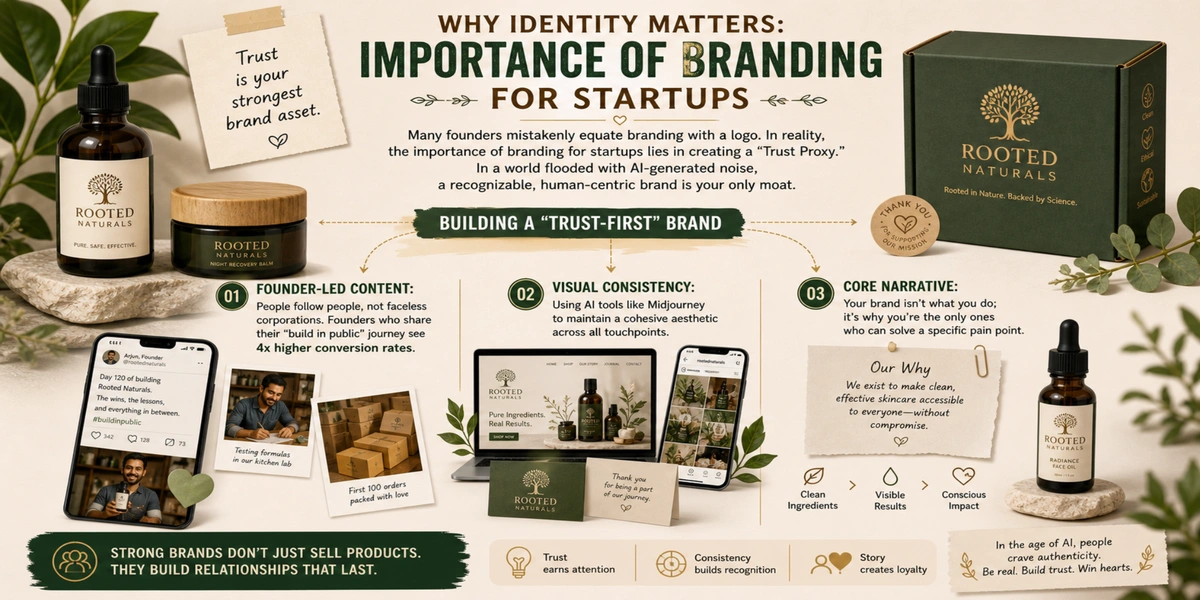
Many founders mistakenly equate branding with a logo. In reality, the importance of branding for startups lies in creating a “Trust Proxy.” In a world flooded with AI-generated noise, a recognizable, human-centric brand is your only moat.
Building a "Trust-First" Brand
1. Founder-Led Content:
People follow people, not faceless corporations. Founders who share their “build in public” journey see 4x higher conversion rates.
People follow people, not faceless corporations. Founders who share their “build in public” journey see 4x higher conversion rates.
2. Visual Consistency:
Using AI tools like Midjourney to maintain a cohesive aesthetic across all touchpoints.
Using AI tools like Midjourney to maintain a cohesive aesthetic across all touchpoints.
3. Core Narrative:
Your brand isn’t what you do; it’s why you’re the only ones who can solve a specific pain point.
Your brand isn’t what you do; it’s why you’re the only ones who can solve a specific pain point.
Overcoming Growth Hurdles: Challenges Faced by Startups
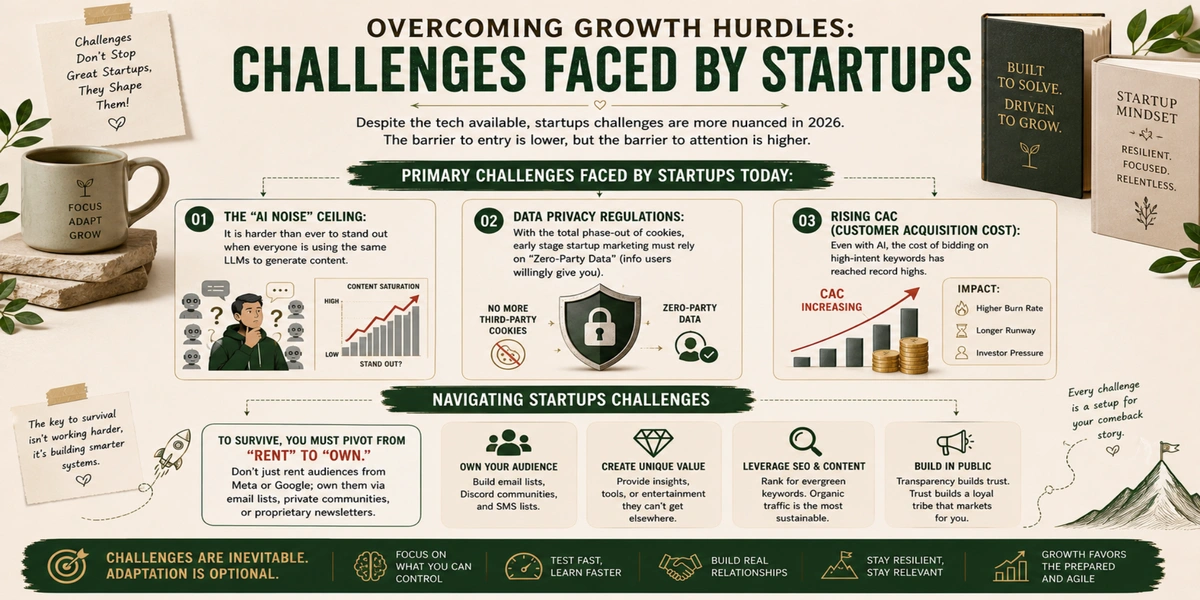
Despite the tech available, startups challenges are more nuanced in 2026. The barrier to entry is lower, but the barrier to attention is higher.
Primary Challenges Faced by Startups Today:
1. The “AI Noise” Ceiling:
It is harder than ever to stand out when everyone is using the same LLMs to generate content.
It is harder than ever to stand out when everyone is using the same LLMs to generate content.
2. Data Privacy Regulations:
With the total phase-out of cookies, early stage startup marketing must rely on “Zero-Party Data” (info users willingly give you).
With the total phase-out of cookies, early stage startup marketing must rely on “Zero-Party Data” (info users willingly give you).
3. Rising CAC (Customer Acquisition Cost):
Even with AI, the cost of bidding on high-intent keywords has reached record highs.
Even with AI, the cost of bidding on high-intent keywords has reached record highs.
Navigating Startups Challenges
To survive, you must pivot from “Rent” to “Own.” Don’t just rent audiences from Meta or Google; own them via email lists, private Discord communities, or proprietary newsletters.
5 High-Impact Growth Hacks for Startups (2026)
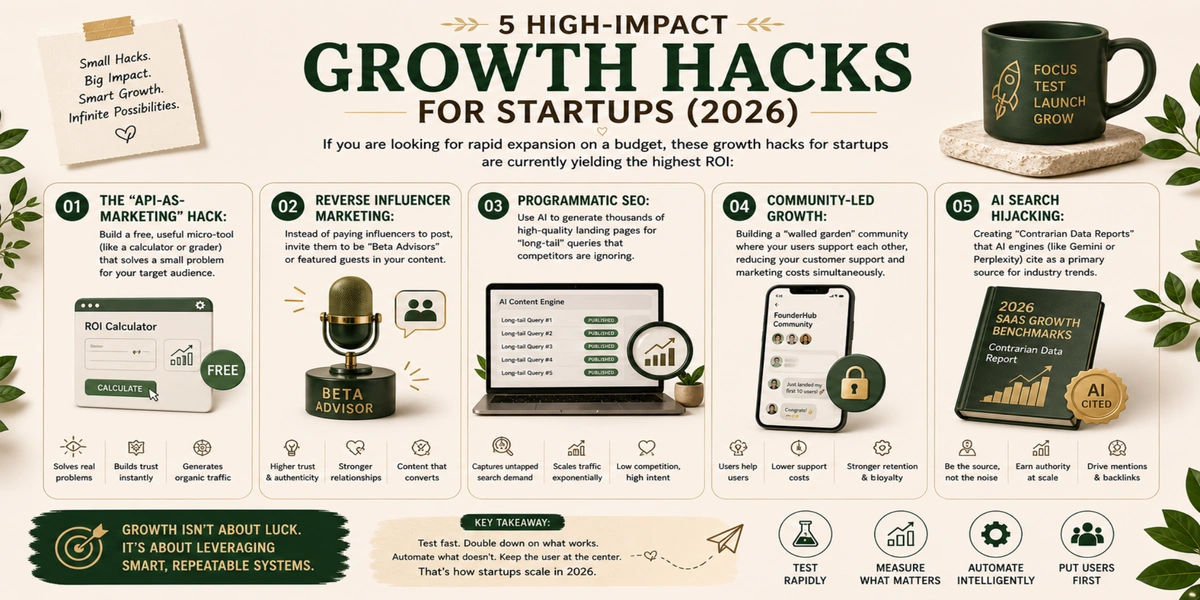
If you are looking for rapid expansion on a budget, these growth hacks for startups are currently yielding the highest ROI:
1. The “API-as-Marketing” Hack:
Build a free, useful micro-tool (like a calculator or grader) that solves a small problem for your target audience.
Build a free, useful micro-tool (like a calculator or grader) that solves a small problem for your target audience.
2. Reverse Influencer Marketing:
Instead of paying influencers to post, invite them to be “Beta Advisors” or featured guests in your content.
Instead of paying influencers to post, invite them to be “Beta Advisors” or featured guests in your content.
3. Programmatic SEO:
Use AI to generate thousands of high-quality landing pages for “long-tail” queries that competitors are ignoring.
Use AI to generate thousands of high-quality landing pages for “long-tail” queries that competitors are ignoring.
4. Community-Led Growth:
Building a “walled garden” community where your users support each other, reducing your customer support and marketing costs simultaneously.
Building a “walled garden” community where your users support each other, reducing your customer support and marketing costs simultaneously.
5. AI Search Hijacking:
Creating “Contrarian Data Reports” that AI engines (like Gemini or Perplexity) cite as a primary source for industry trends.
Creating “Contrarian Data Reports” that AI engines (like Gemini or Perplexity) cite as a primary source for industry trends.
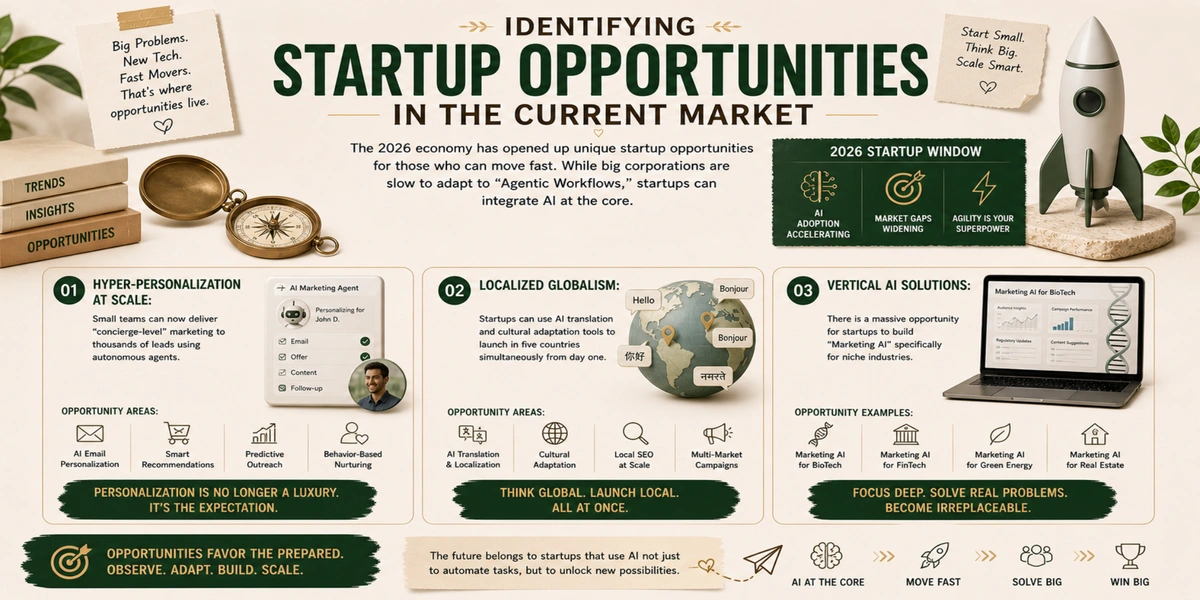
Identifying Startup Opportunities in the Current Market
The 2026 economy has opened up unique startup opportunities for those who can move fast. While big corporations are slow to adapt to “Agentic Workflows,” startups can integrate AI at the core.
1. Hyper-Personalization at Scale:
Small teams can now deliver “concierge-level” marketing to thousands of leads using autonomous agents.
Small teams can now deliver “concierge-level” marketing to thousands of leads using autonomous agents.
2. Localized Globalism:
Startups can use AI translation and cultural adaptation tools to launch in five countries simultaneously from day one.
Startups can use AI translation and cultural adaptation tools to launch in five countries simultaneously from day one.
3. Vertical AI Solutions:
There is a massive opportunity for startups to build “Marketing AI” specifically for niche industries (e.g., Marketing for BioTech or Marketing for Green Energy).
There is a massive opportunity for startups to build “Marketing AI” specifically for niche industries (e.g., Marketing for BioTech or Marketing for Green Energy).
Essential Marketing Tools for Startups
You don’t need a massive team; you need a powerful “Agentic Stack.”
Tool Category | 2026 Leader | Purpose |
Strategy & Copy | Gemini / ChatGPT | Brainstorming and drafting "Snippet-friendly" content. |
Visuals & Video | Sora / HeyGen | Professional video ads without a production crew. |
Analytics | Predictive marketing and automated budget adjustments. | |
Automation | Make.com | Connecting CRM, email, and social into one ecosystem. |
Summary: Scaling Through the Noise
Successfully executing marketing in startups requires a balance of speed and soul. While growth hacks for startups can provide a temporary spike, long-term success comes from understanding the importance of branding for startups and building a community that genuinely cares about your mission.
The challenges faced by startups are significant, but for those who leverage AI correctly and focus on human connection, the startup opportunities have never been greater.
FAQ's
Market an early-stage startup by focusing on “Founder-Led Branding,” building “Growth Loops” into the product, and using “Programmatic SEO” to capture niche search intent. Avoid broad, expensive ad campaigns until you have validated your product-market fit.
The biggest challenge is “Attention Fragmentation.” Users are spread across AI chatbots, social search (TikTok/Reddit), and private communities, making it harder to track the customer journey.
A startup marketing strategy is a specialized plan focused on rapid growth and brand building with limited resources. Unlike traditional marketing, it relies heavily on data-backed experimentation, identifying “Product-Market Fit,” and targeting “Early Adopters” who can provide social proof. It typically prioritizes high-ROI digital channels like SEO, content marketing, and social media to build a foundation before scaling with paid advertising.
Startups use the “Bullseye Framework” to find the most effective channel. This involves brainstorming every possible avenue (from viral marketing to offline events), running cheap, rapid tests on the top three contenders, and then “doubling down” on the single channel that shows the lowest customer acquisition cost (CAC). The goal is to avoid spreading thin and instead dominate one platform where the target audience is most active.
Growth Hacking is a subset of marketing that focuses exclusively on rapid, low-cost scaling through product-led tactics, such as referral loops or automated tools. While traditional marketing often focuses on top-of-funnel awareness (TV, Billboards, Branding), growth hacking looks at the entire customer journey including retention and referral using technical “hacks” to turn the product itself into a marketing machine.