The Ultimate Guide to Product Packaging Design: From Idea to Printing
The Ultimate Guide to Product Packaging Design: From Idea to Printing
In a world where thousands of products vie for attention on a single shelf, your packaging is often the first and sometimes only chance to make a lasting impression. Product packaging design is no longer just about protecting what’s inside; it’s a silent salesman, a brand storyteller, and a crucial component of the user experience.
Whether you are a startup founder or an established brand manager, mastering the transition from a product design idea to a physical, printed box is a complex journey. This guide breaks down the professional product design process into actionable steps to help you create packaging that resonates and converts.
The Importance Of Product Packaging
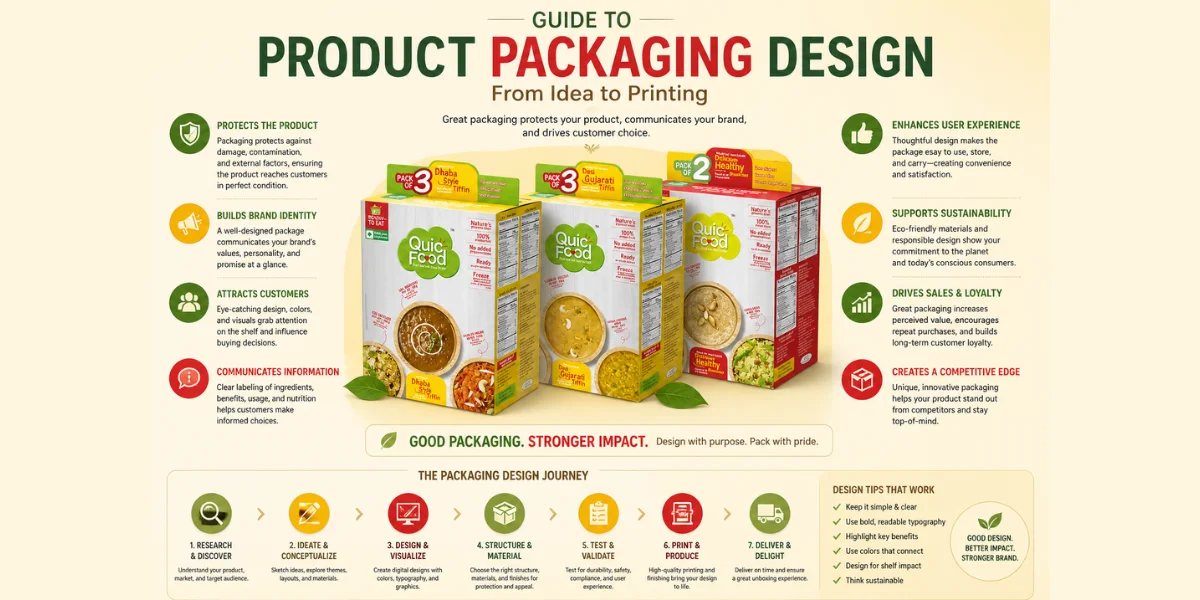
Before diving into the “how,” we must understand the “why.” Research suggests that roughly 70% of purchasing decisions are made in-store. Design for product success begins with understanding that your box is a marketing powerhouse.
1. Brand Identity:
It’s the physical embodiment of your brand’s values.
It’s the physical embodiment of your brand’s values.
2. Protection & Utility:
It ensures the product reaches the consumer intact.
It ensures the product reaches the consumer intact.
3. Information Hub:
It communicates ingredients, instructions, and legal requirements.
It communicates ingredients, instructions, and legal requirements.
4. Sustainability:
Modern consumers prioritize eco-friendly materials, making “green” design a competitive advantage.
Modern consumers prioritize eco-friendly materials, making “green” design a competitive advantage.
Phase 1:
The Research & Strategy (The "Idea")
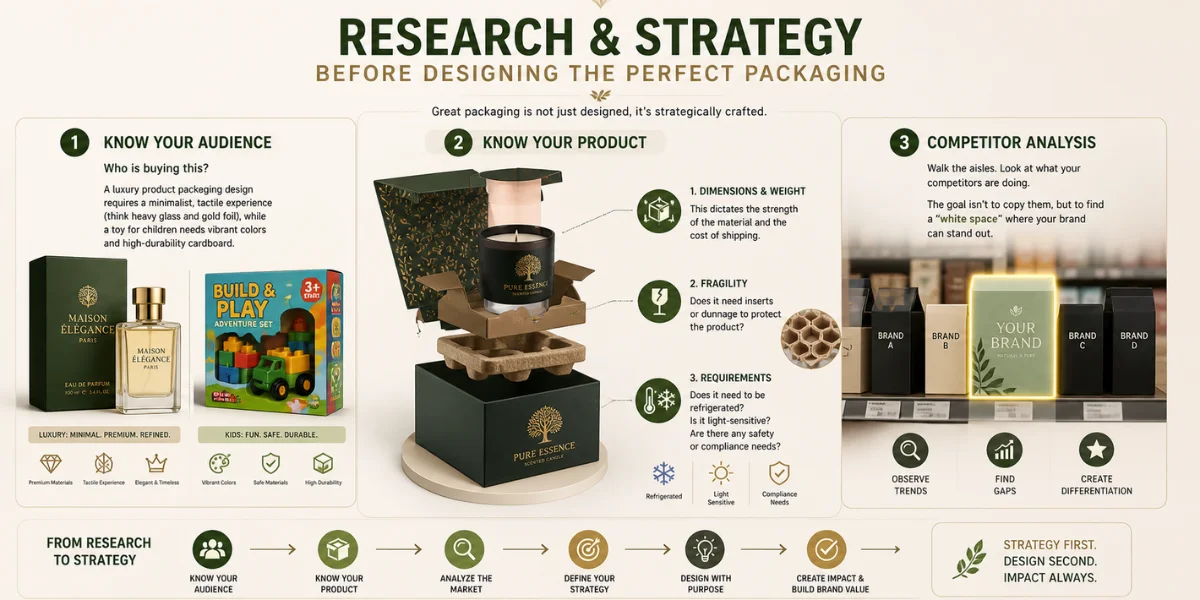
Great design doesn’t start with a sketch; it starts with a question. You cannot execute a creative product packaging design without knowing your constraints.
1. Know Your Audience
Who is buying this? A luxury product packaging design requires a minimalist, tactile experience (think heavy glass and gold foil), while a toy for children needs vibrant colors and high-durability cardboard.
2. Know Your Product
1. Dimensions & Weight:
This dictates the strength of the material.
This dictates the strength of the material.
2. Fragility:
Does it need inserts or dunnage?
Does it need inserts or dunnage?
3. Requirements:
Does it need to be refrigerated? Is it light-sensitive?
Does it need to be refrigerated? Is it light-sensitive?
3. Competitor Analysis
Walk the aisles. Look at what your competitors are doing. The goal isn’t to copy them, but to find a “white space” where your brand can stand out.
Phase 2:
Choosing Your Packaging Type
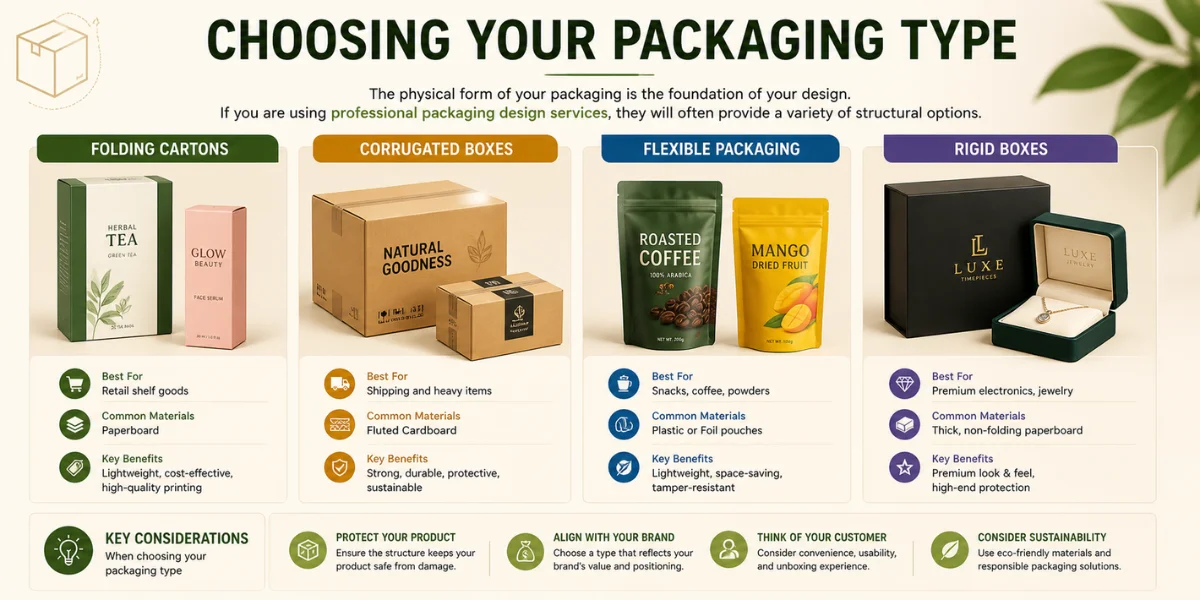
The physical form of your packaging is the foundation of your design. If you are using professional packaging design services, they will often provide a variety of structural options.
Packaging Type | Best For | Common Materials |
Folding Cartons | Retail shelf goods | Paperboard |
Corrugated Boxes | Shipping and heavy items | Fluted Cardboard |
Flexible Packaging | Snacks, coffee, powders | Plastic or Foil pouches |
Rigid Boxes | Premium electronics, jewelry | Thick, non-folding paperboard |
Phase 3:
The Creative Design Process
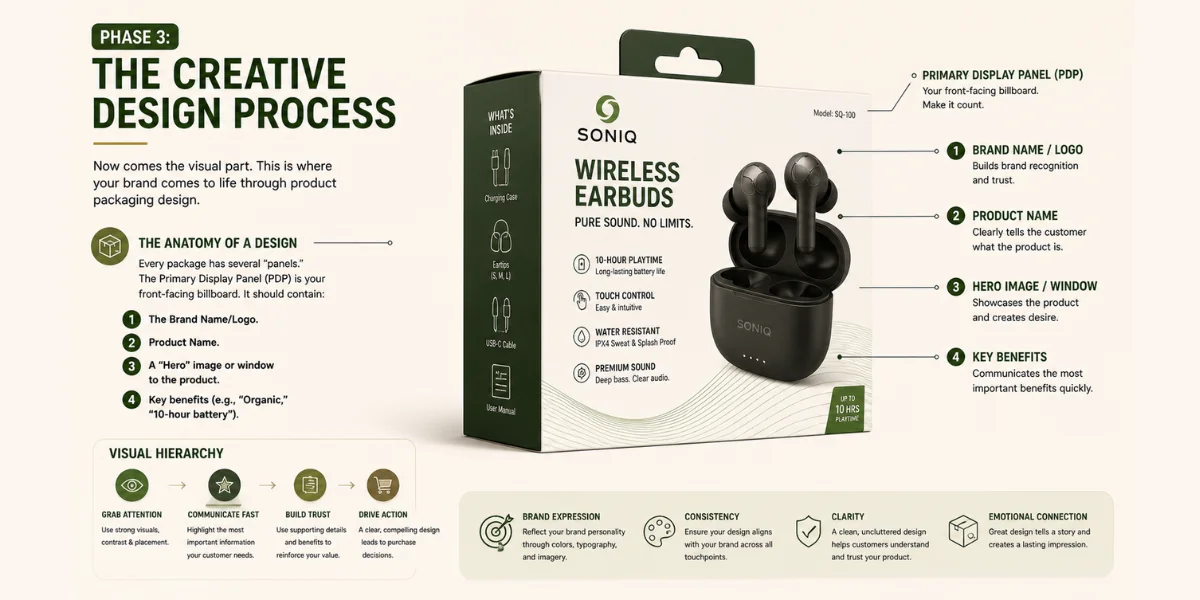
Now comes the visual part. This is where your brand comes to life through product packaging design.
The Anatomy of a Design
Every package has several “panels.” The Primary Display Panel (PDP) is your front-facing billboard. It should contain:
1. The Brand Name/Logo.
2. Product Name.
3. A “Hero” image or window to the product.
4. Key benefits (e.g., “Organic,” “10-hour battery”).
Visual Hierarchy
You have about 2.8 seconds to catch a shopper’s eye. Arrange your elements so the most important information is seen first. Use color theory to evoke emotion blue for trust, red for energy, or green for health.
Phase 4:
Technical Requirements & Dielines
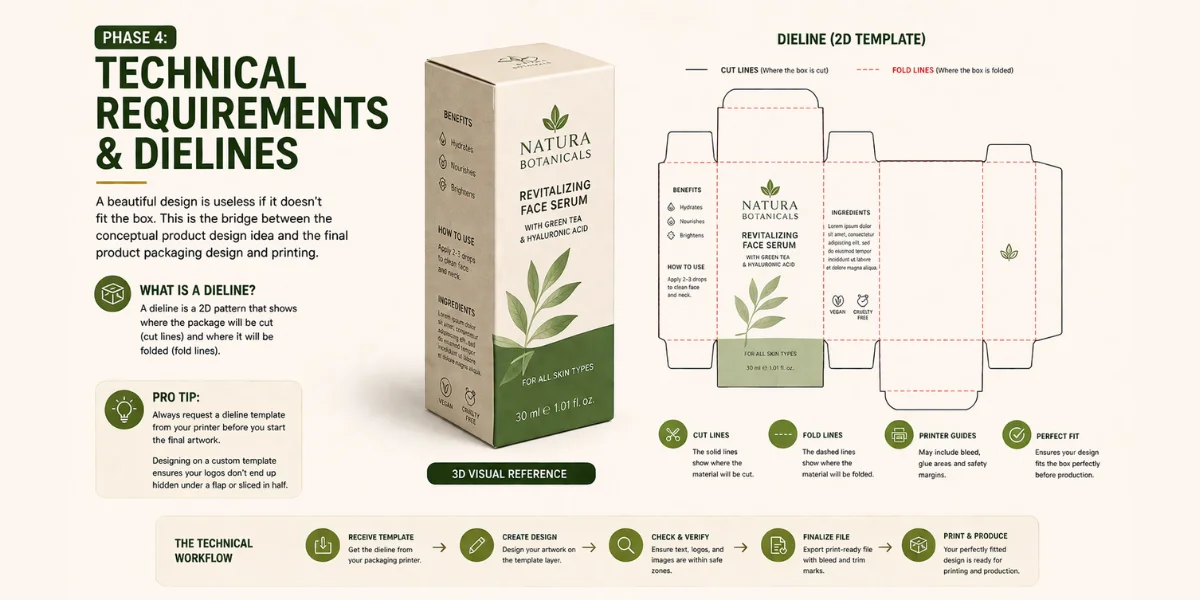
A beautiful design is useless if it doesn’t fit the box. This is the bridge between the conceptual product design idea and the final product packaging design and printing.
What is a Dieline?
A dieline is a 2D pattern that shows where the package will be cut (cut lines) and where it will be folded (fold lines).
• Pro Tip:
Always request a dieline template from your printer before you start the final artwork. Designing on a custom template ensures your logos don’t end up hidden under a flap or sliced in half.
Always request a dieline template from your printer before you start the final artwork. Designing on a custom template ensures your logos don’t end up hidden under a flap or sliced in half.
Phase 5:
Materials and Sustainability
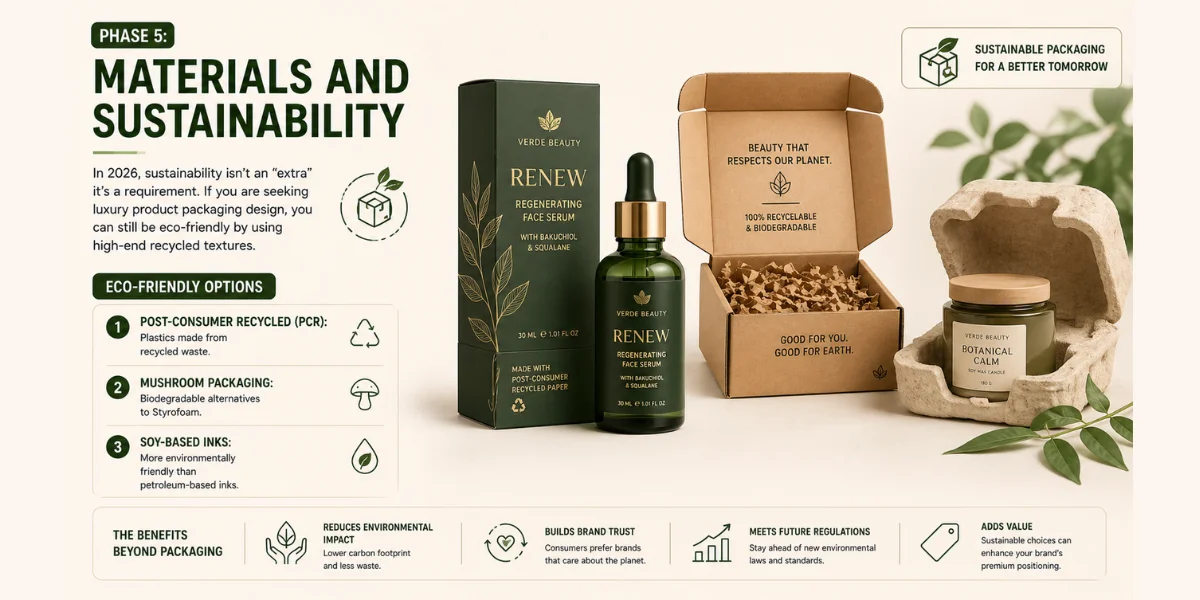
In 2026, sustainability isn’t an “extra” it’s a requirement. If you are seeking luxury product packaging design, you can still be eco-friendly by using high-end recycled textures.
Eco-Friendly Options
1. Post-Consumer Recycled (PCR):
Plastics made from recycled waste.
Plastics made from recycled waste.
2. Mushroom Packaging:
Biodegradable alternatives to Styrofoam.
Biodegradable alternatives to Styrofoam.
3. Soy-based Inks:
More environmentally friendly than petroleum-based inks.
More environmentally friendly than petroleum-based inks.
Phase 6:
Product Packaging Design and Printing
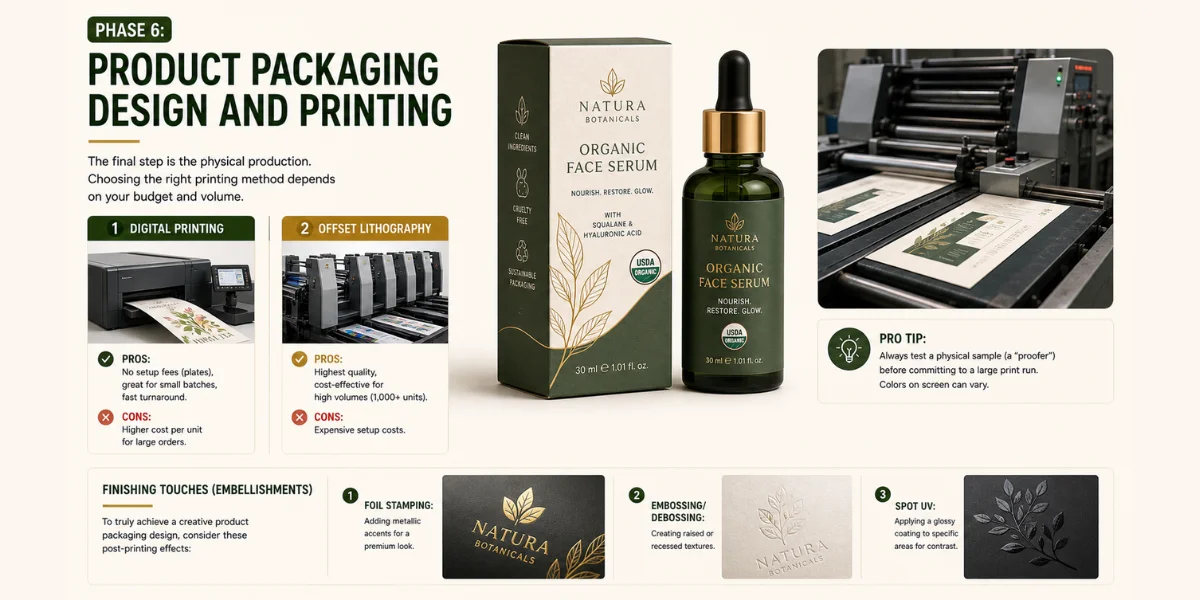
The final step is the physical production. Choosing the right printing method depends on your budget and volume.
1. Digital Printing
1. Pros:
No setup fees (plates), great for small batches, fast turnaround.
No setup fees (plates), great for small batches, fast turnaround.
2. Cons:
Higher cost per unit for large orders.
Higher cost per unit for large orders.
2. Offset Lithography
1. Pros:
Highest quality, cost-effective for high volumes (1,000+ units).
Highest quality, cost-effective for high volumes (1,000+ units).
2. Cons:
Expensive setup costs.
Expensive setup costs.
Finishing Touches (Embellishments)
To truly achieve a creative product packaging design, consider these post-printing effects:
1. Foil Stamping:
Adding metallic accents for a premium look.
Adding metallic accents for a premium look.
2. Embossing/Debossing:
Creating raised or recessed textures.
Creating raised or recessed textures.
3. Spot UV:
Applying a glossy coating to specific areas for contrast.
Applying a glossy coating to specific areas for contrast.
Common Mistakes to Avoid in Product Packaging Design
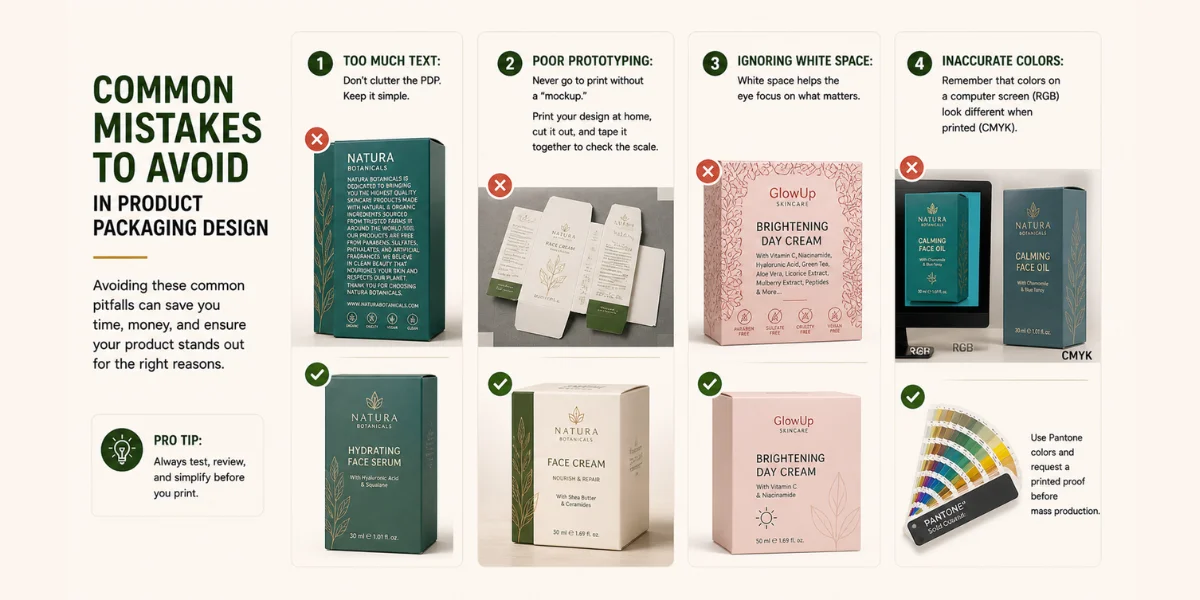
1. Too Much Text:
Don’t clutter the PDP. Keep it simple.
Don’t clutter the PDP. Keep it simple.
2. Poor Prototyping:
Never go to print without a “mockup.” Print your design at home, cut it out, and tape it together to check the scale.
Never go to print without a “mockup.” Print your design at home, cut it out, and tape it together to check the scale.
3. Ignoring White Space:
White space helps the eye focus on what matters.
White space helps the eye focus on what matters.
4. Inaccurate Colors:
Remember that colors on a computer screen (RGB) look different when printed (CMYK).
Remember that colors on a computer screen (RGB) look different when printed (CMYK).
Conclusion
Product packaging design is a blend of art, psychology, and engineering. From the initial product design process to the final stages of product packaging design and printing, every detail matters. By investing in quality packaging design services and focusing on the importance of product packaging, you ensure your product doesn’t just sit on a shelf it moves into the customer’s cart.
FAQ's
Begin with a mood board. Collect images, textures, and colors that represent the “feeling” of your brand before moving into technical sketches.
It often involves specialized materials (velvet touch, heavy-weight board) and complex printing finishes like multi-level embossing that require more time and precision.
The prototyping stage. Seeing a physical 3D version of your package prevents costly errors before mass production.
Design is the bridge between a product’s technical function and the user’s needs. It is important because it dictates usability, safety, and emotional appeal. Beyond aesthetics, good design solves problems, reduces manufacturing costs through smart material choices, and differentiates a brand in a saturated market. A well-designed product builds trust and creates a seamless user experience that leads to long-term customer loyalty.
To excel in product design, you need a multidisciplinary education that blends artistic creativity with technical engineering. Key areas of study include:
- Industrial Design: Learning form, ergonomics, and 3D modeling.
- User Experience (UX): Understanding consumer psychology and how people interact with physical objects.
- Materials Science: Studying the properties and sustainability of plastics, metals, textiles, and organic materials.
- Computer-Aided Design (CAD): Mastering software like Rhino, SolidWorks, or Fusion 360 to create technical blueprints.
- Manufacturing Processes: Understanding how products are mass-produced (e.g., injection molding, 3D printing).
Creative packaging is essential because it acts as a brand’s “silent ambassador,” often serving as the first physical touchpoint for a consumer. It is important for three primary reasons:
- Market Differentiation: In a crowded retail environment, unique structural shapes and bold visual storytelling help a product stand out on the shelf.
- Perceived Value: Creative, high-quality packaging signals a premium product, justifying a higher price point and building brand prestige.
- The Unboxing Experience: Strategic packaging design turns a simple purchase into a memorable event. Features like custom illustrations, tactile finishes, and “inner-flap” storytelling foster an emotional connection that encourages repeat purchases and social media sharing.