
The Golden Jar: Mastering Cow Ghee Packaging Design
The Golden Jar: Mastering Cow Ghee Packaging Design
In the world of dairy, few products carry the spiritual, medicinal, and culinary weight of cow ghee. But on a crowded retail shelf, how do you ensure your “liquid gold” doesn’t just blend in? Cow ghee packaging design is about more than just a label; it’s about evoking heritage, purity, and trust.
Whether you are launching a boutique organic brand or scaling a commercial dairy, your dairy product packaging design serves as your silent salesperson. Let’s dive into how to craft a visual identity that resonates.
The Strategic Vision: How should you approach the design process for cow ghee?
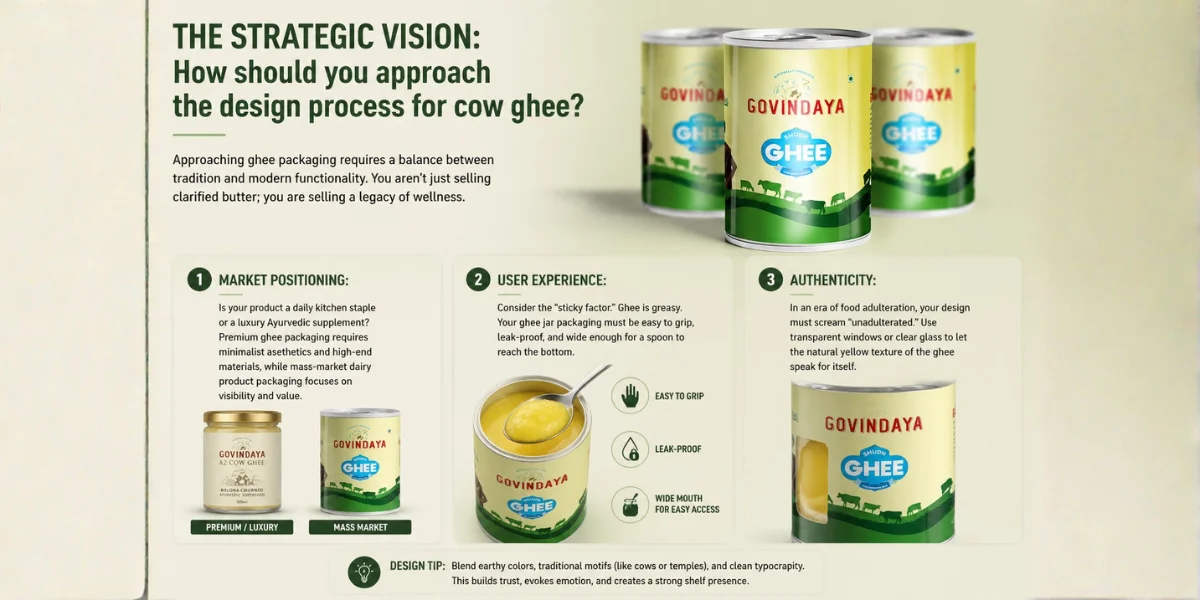
Approaching ghee packaging requires a balance between tradition and modern functionality. You aren’t just selling clarified butter; you are selling a legacy of wellness.
1. Market Positioning:
Is your product a daily kitchen staple or a luxury Ayurvedic supplement? Premium ghee packaging requires minimalist aesthetics and high-end materials, while mass-market dairy product packaging focuses on visibility and value.
Is your product a daily kitchen staple or a luxury Ayurvedic supplement? Premium ghee packaging requires minimalist aesthetics and high-end materials, while mass-market dairy product packaging focuses on visibility and value.
2. User Experience:
Consider the “sticky factor.” Ghee is greasy. Your ghee jar packaging must be easy to grip, leak-proof, and wide enough for a spoon to reach the bottom.
Consider the “sticky factor.” Ghee is greasy. Your ghee jar packaging must be easy to grip, leak-proof, and wide enough for a spoon to reach the bottom.
3. Authenticity:
In an era of food adulteration, your design must scream “unadulterated.” Use transparent windows or clear glass to let the natural yellow texture of the ghee speak for itself.
In an era of food adulteration, your design must scream “unadulterated.” Use transparent windows or clear glass to let the natural yellow texture of the ghee speak for itself.
The Visual Foundation: What are the core design elements of a high-impact ghee label?
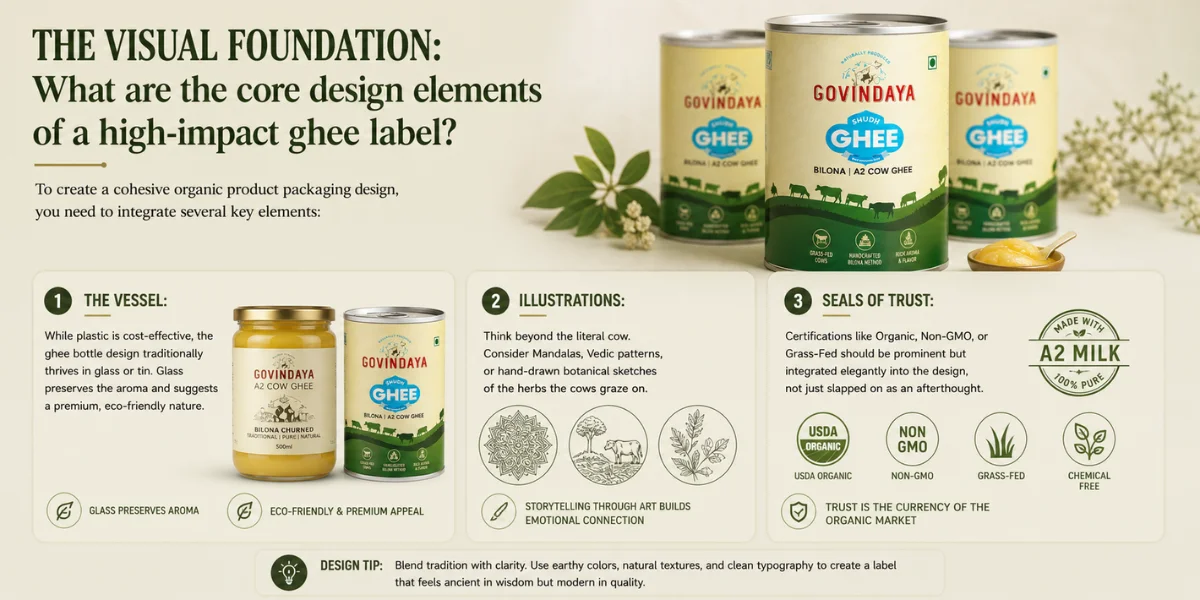
To create a cohesive organic product packaging design, you need to integrate several key elements:
1. The Vessel:
While plastic is cost-effective, the ghee bottle design traditionally thrives in glass or tin. Glass preserves the aroma and suggests a premium, eco-friendly nature.
While plastic is cost-effective, the ghee bottle design traditionally thrives in glass or tin. Glass preserves the aroma and suggests a premium, eco-friendly nature.
2. Illustrations:
Think beyond the literal cow. Consider Mandalas, Vedic patterns, or hand-drawn botanical sketches of the herbs the cows graze on.
Think beyond the literal cow. Consider Mandalas, Vedic patterns, or hand-drawn botanical sketches of the herbs the cows graze on.
3. Seals of Trust:
Certifications like Organic, Non-GMO, or Grass-Fed should be prominent but integrated elegantly into the design, not just slapped on as an afterthought.
Certifications like Organic, Non-GMO, or Grass-Fed should be prominent but integrated elegantly into the design, not just slapped on as an afterthought.
The Psychology of Color: Which palette best represents purity and heritage For Dairy Products Packaging?
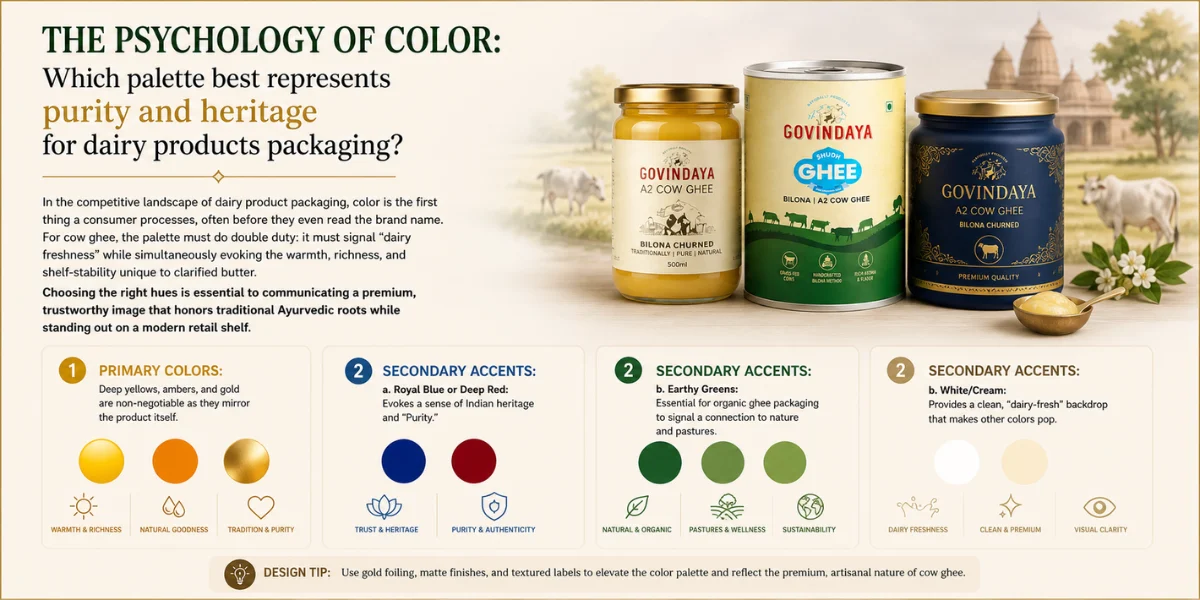
In the competitive landscape of dairy product packaging, color is the first thing a consumer processes, often before they even read the brand name. For cow ghee, the palette must do double duty: it must signal “dairy freshness” while simultaneously evoking the warmth, richness, and shelf-stability unique to clarified butter. Choosing the right hues is essential to communicating a premium, trustworthy image that honors traditional Ayurvedic roots while standing out on a modern retail shelf.
1. Primary Colors:
Deep yellows, ambers, and gold are non-negotiable as they mirror the product itself.
Deep yellows, ambers, and gold are non-negotiable as they mirror the product itself.
2. Secondary Accents:
* Royal Blue or Deep Red: Evokes a sense of Indian heritage and “Purity.”
* Royal Blue or Deep Red: Evokes a sense of Indian heritage and “Purity.”
a. Earthy Greens:
Essential for organic ghee packaging to signal a connection to nature and pastures.
Essential for organic ghee packaging to signal a connection to nature and pastures.
b. White/Cream:
Provides a clean, “dairy-fresh” backdrop that makes other colors pop.
Provides a clean, “dairy-fresh” backdrop that makes other colors pop.
Crafting the Narrative: How should you build a brand story around your ghee?
In a competitive market, people buy “why” you make it, not just “what” you make. Your brand story should center on:
1. Sourcing (The Origin):
Is it A2 Gir Cow ghee? Is it sourced from small Himalayan farms?
Is it A2 Gir Cow ghee? Is it sourced from small Himalayan farms?
2. Process (The Ritual):
Do you use the traditional Bilona method (hand-churning)? Highlighting a slow, artisanal process adds perceived value.
Do you use the traditional Bilona method (hand-churning)? Highlighting a slow, artisanal process adds perceived value.
3. Wellness (The Benefit):
Focus on the “Ojas” (vitality) or the Ayurvedic benefits. Your story should make the consumer feel like they are bringing an ancient wellness secret into their modern kitchen.
Focus on the “Ojas” (vitality) or the Ayurvedic benefits. Your story should make the consumer feel like they are bringing an ancient wellness secret into their modern kitchen.
Effective Communication: How do you highlight your USP on your Dairy Product Packaging?
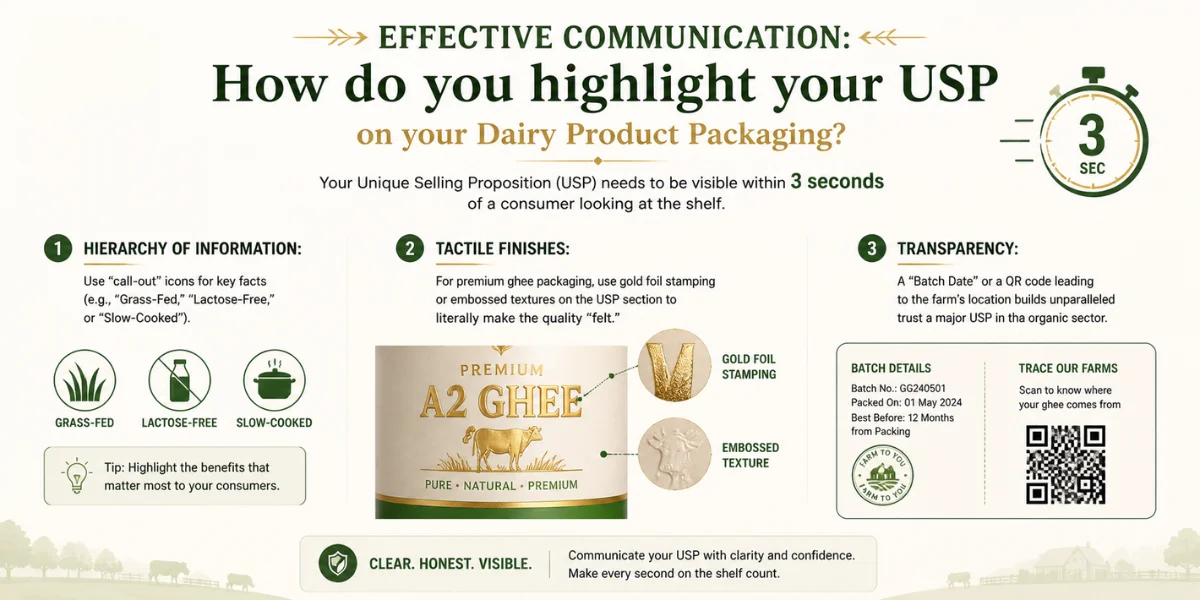
Your Unique Selling Proposition (USP) needs to be visible within 3 seconds of a consumer looking at the shelf when it comes to dairy product packaging.
1. Hierarchy of Information:
Use “call-out” icons for key facts (e.g., “Grass-Fed,” “Lactose-Free,” or “Slow-Cooked”).
Use “call-out” icons for key facts (e.g., “Grass-Fed,” “Lactose-Free,” or “Slow-Cooked”).
2. Tactile Finishes:
For premium ghee packaging, use gold foil stamping or embossed textures on the USP section to literally make the quality “felt.”
For premium ghee packaging, use gold foil stamping or embossed textures on the USP section to literally make the quality “felt.”
3. Transparency:
A “Batch Date” or a QR code leading to the farm’s location builds unparalleled trust a major USP in the organic sector.
A “Batch Date” or a QR code leading to the farm’s location builds unparalleled trust a major USP in the organic sector.
The Art of Lettering: Which typography styles suit cow ghee packaging?

Typography sets the “voice” of your brand.
1. For Heritage Brands:
Use elegant, serif fonts or scripts that mimic calligraphy. This suggests history and “the old ways” of making ghee.
Use elegant, serif fonts or scripts that mimic calligraphy. This suggests history and “the old ways” of making ghee.
2. For Modern/Minimalist Brands:
Use clean, bold sans-serif fonts. This appeals to the health-conscious millennial who values clarity and transparency.
Use clean, bold sans-serif fonts. This appeals to the health-conscious millennial who values clarity and transparency.
3. Secondary Text:
Keep the nutritional info and “how to use” sections in a highly legible, simple font. Never sacrifice readability for style when it comes to legal disclosures.
Keep the nutritional info and “how to use” sections in a highly legible, simple font. Never sacrifice readability for style when it comes to legal disclosures.
The Bottom Line: Product Packaging Importance
Never underestimate product packaging importance; it is the final bridge between your hard work in the dairy and the consumer’s kitchen. A well-designed ghee jar doesn’t just hold a product; it holds a promise of health, taste, and tradition.
Pro Tip:
Always test your packaging design under the specific lighting of a retail aisle. What looks gold in your studio might look muddy under supermarket fluorescents!
Always test your packaging design under the specific lighting of a retail aisle. What looks gold in your studio might look muddy under supermarket fluorescents!
FAQ's
Product packaging is the physical container or wrapping that protects a product during storage, transport, and sale. Labelling is the written, electronic, or graphic communication on the packaging that provides essential details, such as ingredients, usage instructions, safety warnings, and brand identification. Together, they form the final presentation of a product to the consumer.
Yes, it is essential for three primary reasons: protection, preservation, and information. It shields the product from physical damage and environmental factors like moisture or light. Additionally, it ensures consumer safety by preventing tampering and provides a legal platform to communicate mandatory health and regulatory data.
Absolutely. Packaging is often called the “Silent Salesman” because it is the last marketing message a consumer sees before making a purchase decision. It communicates brand identity through colors, typography, and design, helping a product stand out on a crowded shelf and reinforcing brand loyalty through the “unboxing” experience.
- Primary: The packaging in direct contact with the product (e.g., a ghee jar).
- Secondary: The box or wrap that holds multiple primary units together (e.g., a carton of 12 jars).
- Tertiary: The bulk handling packaging used for shipping and warehouse storage (e.g., a palletized wooden crate or large corrugated box).
Packaging design uses “Visual Shorthand” to trigger specific emotions; for example, green and earthy tones suggest “organic” or “natural,” while gold foiling signals “luxury” and “premium quality.” The shape and weight of a container can also influence a buyer’s perception of value heavier glass jars are often perceived as more trustworthy and high-end than lightweight plastic.


