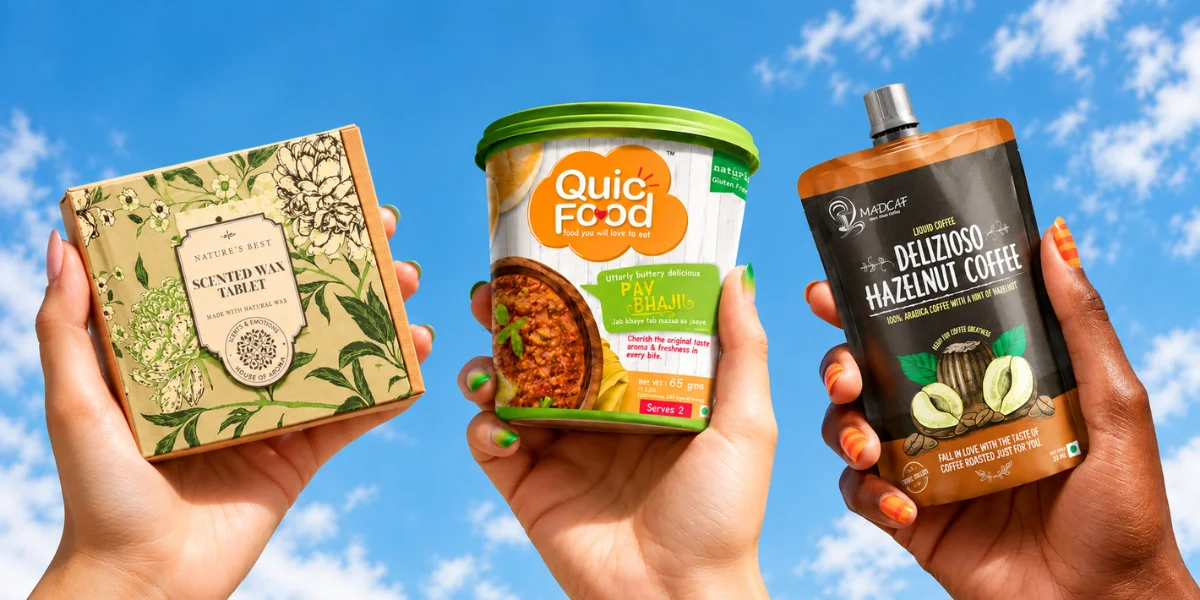
Picture a millet cookie founder in Indore asking a printer how to design packaging for food products, and getting back a quote form and a thumbs-up emoji. The cookies took eight months to get right. The pack is due in three weeks. Nobody has said a word yet about shelf life, the back label, or what the pouch will look like as a tiny square on a quick-commerce app.
That gap is where most food packs go wrong. Not in the logo. In the order of decisions. A founder picks a pretty kraft pouch, a designer fills the front, and only at the printer does someone ask where the nutrition table, the veg mark and the batch number are meant to go.
This guide walks through the whole thing in the order a working packaging designer would: the brief, what the food needs, material, label space, hierarchy, appetite appeal, prototype, print and launch. It’s written for small Indian food brands making snacks, spices, sweets, sauces, ready mixes and bakery products.
If you’re after design ideas rather than a process, Brij Design Studio’s tips on packaging design for food products and its guide to creative food packaging design cover that side.
How to Design Packaging for Food Products, Step by Step

Start with what the food needs to stay fresh and what the law needs printed on it, then design the front to sell. In practice that’s nine steps, done roughly in this order.
1Write a One-Page Brief
Who buys it, where it’s sold, how it should feel, and which packs it will sit next to. One page. If it runs to five, nobody reads it.
2Find Out What the Food Needs
Moisture, oil, light, air, crushing, heat. A pouch of roasted chana and a jar of mango pickle need very different walls around them.
3Pick the Format and Material
Pouch, carton, jar, tin or a bottle with a label. Choose it with the converter, the company that makes the packaging, before any artwork starts.
4Reserve the Label Space
Map every mandatory detail onto the back and side panels first, so the front isn’t fighting for room later.
5Set the Hierarchy
Decide what the eye reads first, second and third. Usually the brand, then the product, then one reason to buy.
6Build Appetite Appeal
Food has to look like something a person wants to eat. Photo, illustration or colour, it should make someone a little hungry.
7Make a Real Prototype
Print it, fold or seal it, fill it with the actual food and leave it on a shelf for a week.
8Proof and Print
Check a hard proof on the real material, then stand at the press for the first sheets if you can.
9Check the Launch Batch
Open cartons from the first delivery, compare them with the approved proof, and shoot the photos for online listings.
Plenty of founders jump straight to step 5 because it’s the fun part. It’s also the step that gets redone when steps 2 to 4 were skipped.
FAQs: Food Packaging Steps
How long does it take to design packaging for a food product?
For one product in one format, a few weeks of design plus printer time is common. A range of variants or a new structure takes longer. The slowest part is usually waiting for approvals and printer samples, not the design itself.
Can I design food packaging before the recipe is final?
You can start on the brand look. Don’t lock the back label, because ingredients, nutrition values and allergens change with the recipe.
What is the first thing to decide when designing food packaging?
Where it will be sold. A kirana shelf, a supermarket aisle, a delivery app and a gift hamper each ask for different things.
Does Brij Design Studio follow a set step-by-step process for food packaging?
Yes. Its packaging page sums up the flow as concept to print, in three stages: concept, structure and print-ready. Every project begins with a deep dive into the product, the audience and the market position.
What Does Food Packaging Design Actually Cover?
Food packaging design covers everything a food product wears: the structure that holds it, the material that keeps it fresh, the graphics that sell it and the information both the law and the shopper need. It’s part engineering, part label writing and part advertising, squeezed onto a few square inches.
It helps to think of a food pack in layers.
- The primary pack touches the food. The pouch around the chips, the jar around the ghee, the foil inside a tin of cookies.
- The secondary pack groups or presents it: a carton holding a sachet, a gift box around four jars, a paper sleeve over a tub.
- The shipper carton moves it to the distributor or the dark store. Shoppers rarely see it. Warehouse staff do, all day, so it still needs clear printing.
Every food pack also does three jobs at once. It keeps the food safe until the printed date, tells the truth about what’s inside, and gets picked up, or tapped, in the couple of seconds a shopper spends deciding. Do two well and one badly, and it still fails. A gorgeous pouch that lets snacks go soft in a month is a refund problem, not a design win.
What it can’t do on its own is create the brand. Name, personality and positioning should exist before the pack does. Packaging carries a brand well. It can’t invent one in a fortnight.
FAQs: What Food Packaging Covers
What is the difference between food packaging and food labelling?
Packaging is the whole container and its design. Labelling is the information printed on it, or stuck on as a label. Every food pack carries labelling, but a label on its own isn’t a full pack.
What are the main types of food packaging?
Flexible packs like pouches and sachets, rigid packs like jars, bottles and tins, and paperboard packs like cartons and boxes. Many products use two of these together, such as a pouch inside a carton.
Is packaging design the same as branding?
No. Branding decides who the company is and how it speaks. Packaging design applies that to a physical product.
Which food pack formats does Brij Design Studio design?
Its packaging page lists stand-up, flat, zipper and spout pouches, folding cartons, product and bottle labels, and luxury formats such as rigid, magnetic and drawer boxes.
Why Do Food Brands Need a Process Before They Need a Designer?
Because the costly mistakes in food packaging are rarely about how the pack looks. They come from decisions made in the wrong order, and they show up after thousands of units are printed.
Printing plates and cylinders are made for a specific design. Change one line of text after they’re made, and new ones are needed. Flexible packaging printers also tend to have minimum order quantities, so one wrong date format or a missing allergen line can mean a stack of unusable pouches sitting in a godown in Bhiwandi.
A process also stops opinions from running the project. Without one, the founder’s cousin, the distributor and the printer all have views on the colour, and nobody checks whether the zip survives a humid monsoon week. With one, each person answers the questions that are actually theirs to answer.
It doesn’t need to be heavy. A two-person brand can run the same steps as a large FMCG company, with fewer meetings.
FAQs: Why a Packaging Process Matters
What happens if food packaging is printed with a label error?
Usually a reprint. Depending on the error, existing stock may need relabelling or may not be sellable at all, which is why catching it at proof stage costs so much less.
Can a small food brand follow the same packaging process as a big company?
Yes, in a lighter form. Fewer people, fewer rounds, same order of steps.
Who should sign off on food packaging artwork?
The founder for the brand side, whoever owns the recipe for ingredients and nutrition, a food regulatory expert for the mandatory text, and the printer for the technical files. On a small team one person may cover two of these. That’s fine, as long as each check really happens.
Why does Brij Design Studio start food packaging projects with research instead of sketches?
Its packaging work begins with a deep dive into the product, the target audience and the market position. The concepts that follow then rest on brand strategy and category understanding rather than guesswork.
How Do Shelf Life and the Food Itself Decide the Material?

The food decides the material, and the material decides a lot of the design. Work out what can spoil the product (moisture, air, light, oil or crushing), pick a pack that blocks it, and only then start on graphics.
Here’s what a few common Indian food categories usually ask for:
- Namkeen, chips and roasted snacks go soft with moisture and stale with air. Laminated or metallised pouches are common, often flushed with nitrogen by the packer.
- Masalas and spice blends lose aroma, and light fades their colour. Barrier pouches or tins work well, with a zip if the pack is used over many meals.
- Pickles, chutneys and sauces bring oil and acid. Glass or food-grade plastic jars with a good seal, and a label that won’t wrinkle or stain when oil runs down the side.
- Mithai and bakery items have a short life and break easily. Cartons with trays or inner wraps, plus space for dates added at the shop.
- Ready mixes and flours are dry but can pick up moisture and pests. Pouches, or cartons with a liner.
Two points get missed a lot. Kraft paper outside usually needs a plastic or foil layer inside to keep food fresh, so a “paper pouch” is rarely paper only. And if the packer fills by machine, the pouch size, film and seal area have to suit that machine. Ask before the designer starts, not after.
The studio’s posts on stand-up pouch packaging design and sustainable packaging design go deeper into pouch features and greener materials. Whatever you pick, test shelf life with the real pack from the real supplier. Shelf-life claims belong to the food technologist or the testing lab, not the designer.
FAQs: Shelf Life and Packaging Material
What is the best packaging material for food products?
There isn’t one. The right material depends on what spoils your food: moisture, air, light, oil or rough handling. A good converter will suggest a structure once they know the product and the shelf life you’re aiming for.
Are kraft paper pouches good for food?
They can be, if there’s a proper barrier layer inside. The kraft outside is mostly about looks and feel.
Does packaging affect the shelf life of food?
A lot. The same snack can last weeks or months depending on the film, the seal and whether the pack was flushed with nitrogen.
Can Brij Design Studio help a food brand decide between a pouch, a box and a label?
Its packaging process moves from structural ideas to visual execution across boxes, pouches, labels and other formats, so the format question is part of the work. Barrier specs and shelf-life testing stay with the brand’s converter and food technologist.
How Much Label Space Does a Food Pack Need?
More than most founders expect. Packaged food sold in India has to carry a set list of information under FSSAI labelling rules (plus legal metrology rules for things like net quantity and MRP), and it has to be readable, so map all of it onto the back and side panels before the front is designed.
In plain words, a typical packaged food label in India needs:
- The name of the food, saying what it actually is.
- Ingredients, listed from the largest amount to the smallest.
- Nutrition information, usually per 100 g or 100 ml, often per serving as well.
- The green veg or brown non-veg symbol.
- Allergen information where it applies, such as nuts, milk, gluten or soy.
- Net quantity and MRP.
- Name and address of the manufacturer or packer, and the brand owner if that’s someone else.
- The FSSAI logo and licence number.
- Batch or lot number, date of manufacture or packing, and the use-by or best-before date.
- Storage instructions where needed, and consumer care details.
Rules get updated and some categories carry extra requirements, so treat this as a starting list, not legal advice. Have a food regulatory consultant or your testing lab check the final text before it reaches the printer.
A few design habits make the back panel far less painful. Leave a clear, light patch where the batch number and dates get printed on the packing line, because a coded date is hard to read on dark ink. Set the nutrition table as a clean box at a readable size, not a squeezed afterthought. And keep room for a barcode if the product is heading to supermarkets or big marketplaces, which commonly ask for one built to the GS1 barcode standards. For label layout itself, the post on product label design has more.
FAQs: Food Label Space and FSSAI Details
What information is mandatory on a food label in India?
In plain terms: the food’s name, ingredients, nutrition information, the veg or non-veg symbol, allergens where relevant, net quantity, MRP, manufacturer or packer details, the FSSAI logo and licence number, batch number, dates and consumer care details. A regulatory expert should check the final wording for your category.
Can the FSSAI details go on the back of the pack?
Most of them usually sit on the back or side panels. The veg or non-veg symbol is expected on the front, near the product name, so check placement with your regulatory expert.
Do I need a barcode on my food packaging?
Not for every sale. A small brand selling in local shops or on its own website may manage without one. Supermarket chains and large marketplaces usually ask for it.
Does Brij Design Studio plan space for mandatory label information in its food packaging designs?
Its process refines hierarchy, typography, colour and brand elements across the pack. The label text itself comes from the brand, and a food regulatory expert should approve it before print.
How Do You Build Hierarchy and Appetite Appeal on a Food Pack?

Decide what a shopper reads first, second and third, then make the food look worth eating. On most food packs the order is the brand, then what the product is, then the flavour or variant, then one reason to buy.
A quick test: print the front at actual size, stick it on a wall, step back three paces and look for two seconds. Then shrink it on a phone to the size it shows up in a quick-commerce search grid. Can you still tell it’s masala peanuts and not a protein bar? If not, the hierarchy needs work. More decoration won’t fix it.
Keep the Front for Four Things
Brand, product, variant, one claim. Everything else (the origin story, the second claim, the “no preservatives, handmade, since 1987” stack) moves to the back or the side. Founders hate this step. They love the product and want to say all of it. But a front with seven claims reads as none.
Make It Look Edible
Appetite appeal usually comes from one of these, and the good packs pick one and commit:
- Photography. A real, well-lit shot of the food sells sauces, sweets and ready meals hard. It has to be honest, though. If the pack shows twelve cashews and the pouch has three, the reviews will say so.
- Illustration. Friendlier, easier to own, and it ages well. Good for snacks, kids’ food and spice blends.
- A window or a flavour colour. A clear window shows the real product. A deep red tells you it’s the chilli one before you read a word.
Watch the category codes too. Shoppers expect certain colours in certain aisles: green and white for health food, hot reds and yellows for spicy snacks, gold and maroon for mithai. Breaking a code on purpose can get a pack noticed. Breaking it by accident can make a pickle look like a floor cleaner. Type matters as much as colour, and the guide to fonts for packaging covers faces that stay readable at small sizes, while these tips on packaging design for food add more visual pointers.
FAQs: Hierarchy and Appetite Appeal
What should be on the front of a food package?
The brand name, what the product is, the variant or flavour, one main reason to buy, and the veg or non-veg mark. Net quantity often sits there too. Keep the rest for the back.
Is a photo or an illustration better on food packaging?
Neither wins every time. Photos sell texture and taste, illustrations are easier to own. Pick one and do it properly.
How do I make my food packaging look good on quick-commerce apps?
Check the front as a tiny square on a phone. A big, simple product name, strong contrast and one clear visual survive that size. Fine detail and small claims disappear.
How does Brij Design Studio make a food pack work on a shelf and on a phone screen?
It refines hierarchy, typography, colour and brand elements so the pack works on shelf and online, and it builds realistic 3D mock-ups so the design can be judged before anything is printed.
What Does the Food Packaging Design Process Look Like From Brief to Press?
A clean process runs in four stretches: research, concepts, artwork and production. Each one ends with a sign-off, so nothing from an earlier stage gets quietly reopened later.
1Research
Walk three or four shops where the product will sell, photograph the shelf and screenshot the category on two delivery apps. Note what everyone does, because that’s the look to avoid.
2Concepts
Two or three clearly different routes, each shown on a 3D mock-up of the real format rather than floating on a white page.
3Artwork
The chosen route goes onto the dieline, the flat template showing cuts, folds, seals and bleed. Get it from your printer or converter, never from a random download. Every variant is built and every word checked.
4Production
Hard proof, colour match, press check, then a look at the first finished packs.
At Brij Design Studio, the packaging page describes this path as concept to print, running through concept, structure and print-ready. The studio moves from structural ideas to visual execution across pouches, boxes and labels, then delivers print-ready artwork and realistic 3D mock-ups made for manufacturing.
Two things slow projects down more than anything else. Late recipe changes, which ripple straight into the back label. And approval by committee. Agree upfront who gives the final yes, and keep it to one or two people.
FAQs: The Food Packaging Design Process
What is a dieline in food packaging?
The flat template of the pack, showing cut lines, folds, seals, glue areas and bleed. Artwork is placed on it so everything lands in the right spot once the pack is made.
How many design concepts should a food brand see?
Two or three real options is usually plenty. More than that tends to end in a mix-and-match that pleases nobody.
Should the printer be involved before the design is finished?
Yes. The printer can flag colour limits, finishes, minimum quantities and file needs early, which saves rework later.
What does a food brand receive at the end of a packaging project with Brij Design Studio?
Print-ready artwork and realistic 3D mock-ups of the packs, prepared so the design reaches production as planned.
What Should You Check Before Printing and at Launch?

Check a filled prototype the way a shopper, a packer and a food inspector would, before approving a single print file. Then check the first delivery against the approved proof.
Questions to Ask Before Print
- “Has the pack been filled with the real product and sealed on the real machine?”
- “Can I read the product name from across the room under a tube light?”
- “Does the front still make sense as a thumbnail on a phone?”
- “Has a regulatory expert approved every word on the back?”
- “Is there a clear patch for the batch number and dates?”
- “Does the zip, tear notch or lid open easily, and does it close again?”
- “Does oil from the food stain the label or carton after a few days?”
- “Has someone scanned the barcode off the printed proof?”
- “Do the colours on the hard proof match what was signed off on screen?”
Checks at Launch
- Open a few cartons from different points in the first delivery and compare colour, cuts and seals with the proof.
- Look for coded dates and batch numbers that are smudged, missing or crooked.
- Photograph the real pack, front, back and sides, on a plain background for marketplace listings.
- Ask two or three shop owners where they put it and what customers asked about it in the first week.
That last one costs nothing and is often the most useful feedback a new brand gets.
FAQs: Pre-Print and Launch Checks
What is a hard proof in packaging printing?
A printed sample of the artwork made before the full run, so colours and details can be checked on the real material instead of a screen.
Should I attend a press check for my food packaging?
If you can, yes, at least for the first run. Colour can shift on press, and it’s far easier to correct while the machine is running than after the job is done.
How do I test food packaging before launch?
Fill it with the real product, seal it, store it normally for a while, drop it, carry it around, open and reclose it, and show it to a few people who match your target shopper.
How does Brij Design Studio prepare food packaging for the printer?
By delivering print-ready artwork built on any printer-supplied dieline, with production coordination needs discussed at the start of the project. Its packaging work runs from concept through to final print output.
What Are the Most Common Mistakes in Food Packaging Design?
The usual ones are designing the front before the back label, choosing a material without testing it with the real food, and crowding the front with claims. Most are cheap to fix on screen and expensive to fix on a printed roll.
There’s a longer list of general errors in the post on packaging design mistakes. These seven are the ones that keep turning up on food.
1Copying the Category Leader
It feels safe. On the shelf, it just makes the pack look like a cheaper version of the one beside it.
2A Tiny Product Name
The brand name is huge, and nobody can tell if it’s chikki or a granola bar.
3Forgetting the Date Coder
Dates printed onto a dark panel become unreadable.
4Lookalike Variants
Five flavours in near-identical colours, so shoppers grab the wrong one and blame the brand.
5Trusting the Screen
Bright screen colours often print duller, especially on kraft paper or matte film.
6Food Photos That Overpromise
A pack shot loaded with nuts and saffron sets up a letdown the moment the pouch is opened.
7No Room to Grow
A design that only works for one product falls apart when the second and third arrive.
FAQs: Common Food Packaging Mistakes
Why does my packaging look different printed than on screen?
A screen shows light. Print is ink sitting on a surface, and different films, papers and finishes change how colours come out. A hard proof on the actual material is the only check worth trusting.
Is it a mistake to use too many colours on a food pack?
Not always. It becomes one when the colours fight the product name or make the variants hard to tell apart.
How can I fix packaging that is already printed with an error?
A sticker can work for some errors, but any change to mandatory information should be cleared with a regulatory expert before relabelling. Then correct the files before the next run.
How does Brij Design Studio help food startups avoid costly packaging mistakes?
By starting with research into the product, audience and category, checking designs on realistic 3D mock-ups before print, and planning for production and print requirements from the start.
Should You Design Food Packaging Yourself, Hire a Freelancer or Work With a Studio?
It depends on how many products you have, how much is riding on the launch and how much time you can give it. Doing it yourself suits a test batch, a freelancer suits one clearly defined pack, and a studio suits a brand launch or a growing range.
Doing It Yourself
Online templates let a founder make a decent-looking label over a weekend. That’s fine for a market stall or twenty jars for friends. The trouble starts at scale: templates don’t know your dieline, your printer’s limits or your mandatory text, and the look is easy to copy.
Hiring a Freelancer
A good freelance packaging designer can do excellent work on a single product. Check that their food packs actually got printed, and that they’ll supply files on the printer’s dieline and answer the printer’s questions. Many are strong on graphics and lighter on structure and print.
Working With a Studio
A studio brings strategy, design, structure and print support under one roof, along with a process it has run many times. It asks for more time and investment upfront. It makes the most sense when the brand is new, the range will grow, or the product is going into supermarkets where the shelf is crowded.
Some founders take a middle road. A studio builds the brand and the first pack system, and an in-house designer follows it for later variants.
FAQs: DIY, Freelancer or Studio
Can I design my own food packaging using templates?
Yes, for a small first batch. Before a bigger print run, get the files checked against the printer’s dieline and the label text checked against the rules.
What should I ask a packaging designer before hiring them?
Ask to see printed food packs they’ve designed, who handles printer files and proofs, how many rounds of changes are included, and who owns the final files.
Is a packaging studio worth it for a small food startup?
It depends on the plan. For one product in one shop, maybe not yet. For a brand aiming at supermarkets and delivery apps within a year, a strong first system usually saves money later.
How is working with Brij Design Studio different from hiring a freelance packaging designer?
Brij Design Studio handles branding, packaging, website design and digital marketing, so a food brand’s pack, identity and online presence can come from one team. Its packaging concepts combine brand strategy, visual communication and category understanding.
How to Design Packaging for Food Products That Can Grow Into a Range

Design the first pack as a system, not a one-off. Fix the parts that stay the same on every product, like logo position, type, layout grid and back panel, and decide up front which parts change, like colour, flavour name and food visual.
Very few food brands stay at one product. Plain makhana becomes peri peri, then cheese, then a gift tin for Diwali. If the first pouch was designed as a single poster, every new flavour turns into a fresh design debate. If it was designed as a system, a new variant is mostly a colour swap and new copy.
Worth planning early:
- A variant colour list with room for at least six flavours, all easy to tell apart under shop lighting.
- A back panel template where only the ingredients, nutrition values and allergens change.
- Size rules, so the layout works on a 50 g sachet and a 1 kg family pack.
- A festive edition approach, so a Diwali or Rakhi box feels special but is clearly the same brand.
- A path to greener materials as suppliers offer them, so a later switch doesn’t force a full redesign.
And know when to redesign. A refresh makes sense when the pack gets confused with competitors, when the range has outgrown the system, or when the brand moves into a new channel. It doesn’t make sense just because the founder is tired of looking at it. The shoppers who buy it every month often aren’t.
FAQs: Growing a Food Packaging Range
How do I design packaging for multiple flavours?
Keep the layout, logo and type fixed, and change one strong element per flavour, usually colour plus the flavour name and a matching visual.
How often should a food brand redesign its packaging?
There’s no fixed cycle. Redesign when the pack stops doing its job, not because a calendar says so.
Can I switch to sustainable packaging later without a full redesign?
Often, yes, as long as the design doesn’t depend on a finish that only works on the current material. Planning for it early makes the switch much smoother.
Can Brij Design Studio design a packaging system for several flavours or variants?
Yes. Its case studies page notes that it builds packaging systems for multiple product variants, carrying one visual system across the range.
Why Choose Brij Design Studio for Food Packaging Design?
Brij Design Studio is a Mumbai design studio working across branding, packaging design, website design and digital marketing. Its packaging work spans pouches, cartons, labels and boxes, and its case studies include food startups, a healthy snack brand launch and confectionery packaging.
Its way of working follows the order in this guide: research into the product, audience and market first, then concepts that combine brand strategy with category understanding, then refinement for shelf and screen, and finally print-ready files for manufacturing.
For a food founder planning a first pack or a full range, the studio’s Mumbai contact page is the place to start.
Conclusion
Designing a food pack well is mostly about order. Food first, then material, then the label space the rules ask for, then the front that sells, then a real prototype, then print. Skip ahead and the fixes still come, just later and at printer prices.
None of this needs a big team. A founder with a clear brief, an honest converter, a careful designer and a regulatory check can put out a pack that holds its own on a kirana shelf and on a phone screen.
Get the back of the pack right, and the front gets a lot easier.
Common FAQs About Designing Food Packaging
How do I start designing packaging for my food product?
Write a short brief covering what it is, who buys it, where it sells and what it competes with. Then talk to a converter about the right format before any artwork begins.
What makes good food packaging design?
It keeps the food fresh, makes the product obvious in a second or two, looks appetising and carries every required detail clearly.
What software is used to design food packaging?
Professional designers use vector design software for artwork and separate tools for 3D mock-ups. Printers usually want print-ready PDF or vector files placed on their dieline.
How much does food packaging design cost?
It depends on the number of products, pack formats, materials and print runs. One label and a full range of pouches and cartons are very different jobs.
Can I use a stock photo on my food packaging?
Only if the licence allows packaging use. Even then, another brand may use the same photo, and it may not look like your real product. A custom shoot or illustration is safer.
Which colours work best for food packaging?
Ones that suit the category and flavour and give the product name strong contrast. Warm colours often suit snacks, but the honest answer depends on what’s already on the shelf.
What is the difference between best before and use by dates?
Broadly, best before is about quality, and the food may still be safe after it. Use by is about safety. Your food technologist decides which one applies to your product.
Do I need different packaging for online and offline sales?
The main pack can usually stay the same. Online orders may need extra protection in the outer box, and the front has to read well as a small image.
Where is Brij Design Studio based?
In Mumbai. The studio works on branding, packaging design, website design and digital marketing.
Has Brij Design Studio designed packaging for food and snack brands before?
Yes. Its case studies include food startups, a healthy snack brand launch and confectionery packaging, and its packaging page shows food pouches, a granola box and a sweets and bakery box.