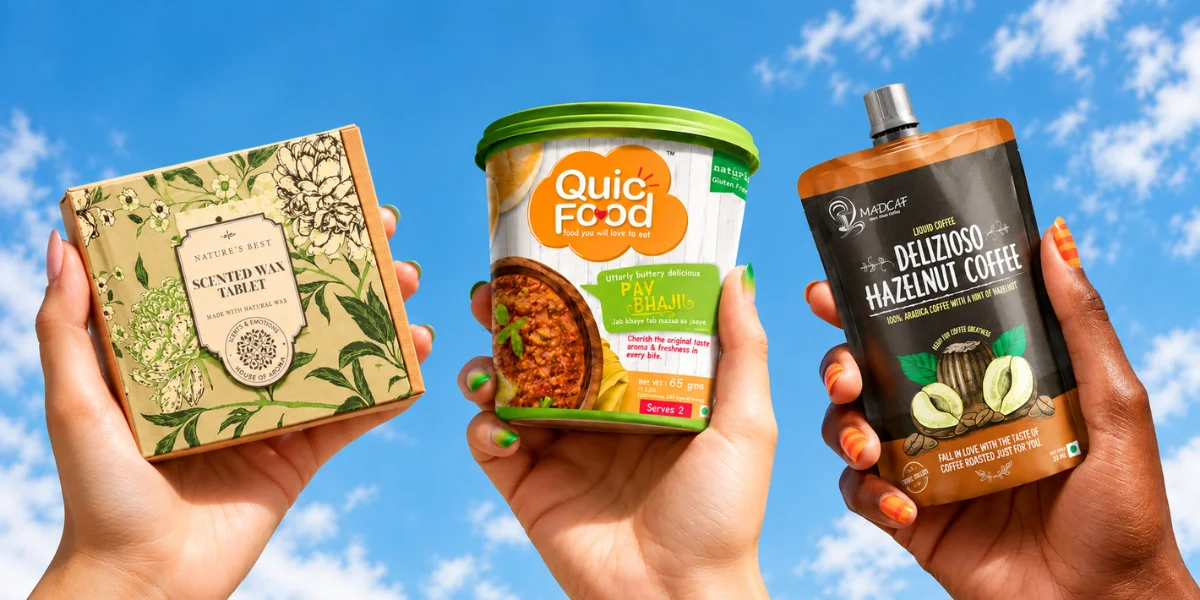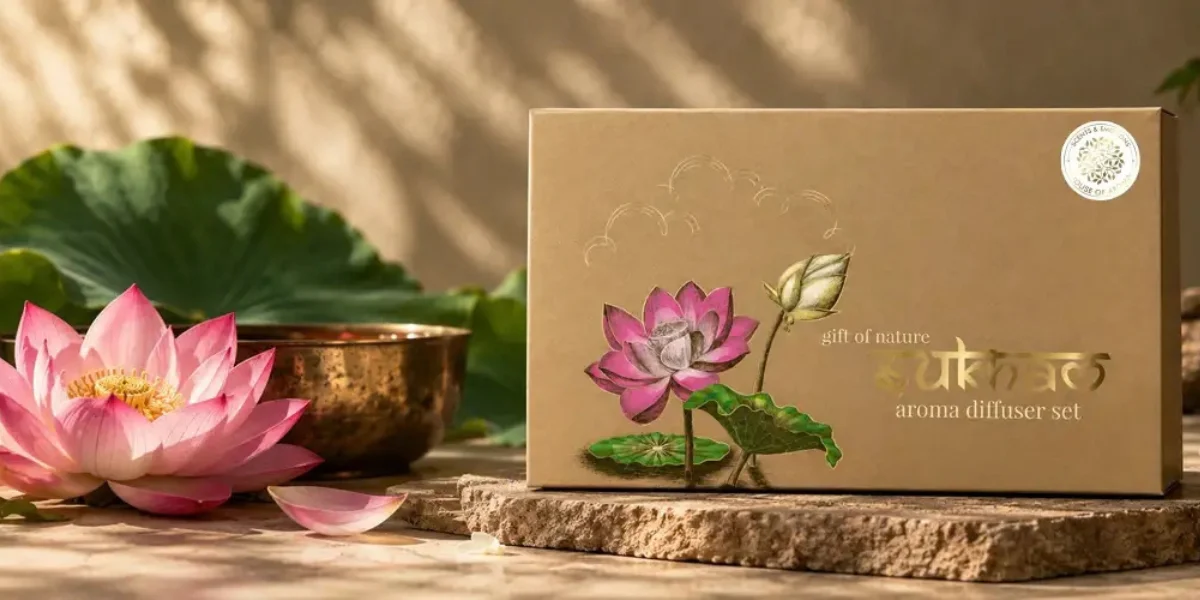
Anyone wondering how packaging helps in advertising should watch the last two seconds of almost any biscuit or shampoo commercial. The story ends, and the product sits there, front facing, while a voice says the name. That frame is the pack shot. The whole ad was walking towards it.
Now say a small banana chips brand in Thrissur runs a few Instagram reels before Onam. People get curious, open a quick-commerce app and type the name. What comes up is a thumbnail no bigger than a thumbprint. If that tiny pack doesn’t look like the one in the reel, the curiosity dies right there.
Then the tin reaches a kitchen in Bhopal and sits on the counter for three weeks. A guest asks where it’s from. Someone photographs it next to the evening chai. Nobody paid for any of that.
This guide looks at the pack as an ad: where it shows up, which campaign packs earn attention, how promotions and QR codes connect it to the rest of the marketing, what the ASCI code expects from the words on a pack, and how to measure it. The wider marketing plan sits in a separate guide on branding and packaging in marketing.
How Packaging Helps in Advertising: Is the Pack Really an Ad?

Yes. A pack is an ad the brand already owns. It carries the name, the promise and the look to every single buyer, on the shelf, inside other ads and at home, with no media bill each time it’s seen.
Marketers sort media into three kinds. Paid media is what a brand buys, like TV slots and sponsored posts. Earned media is what others give for free, like reviews and shares. Owned media is what the brand controls, and that includes the pack. The pack is odd because it slides between all three: owned on the shelf, the star of the paid ad, and earned when a customer films it without being asked.
What a Pack Can Do That an Ad Can’t
- It can’t be skipped. Nobody buys the product without holding the box.
- It’s there at the moment of choice, when last week’s TV ad is a fuzzy memory.
- It keeps working after the sale, in the fridge door or the bathroom cabinet.
- It gets touched. Weight, texture and the click of a lid all say something.
And What It Can’t Do Alone
A pack rarely creates demand out of nothing. It’s a closer and a reminder. A brand-new kind of product still needs an ad to explain it, and a pouch front the width of a palm isn’t the place for that. The ad makes the promise. The pack keeps it, in the same colours and the same words.
FAQs: The Pack as an Ad
Is packaging considered a form of advertising?
Yes. It carries brand messages to buyers the way an ad does. In India, the ASCI code even lists written and graphic matter on packaging among the things it covers.
Why is packaging called the silent salesman?
Because it does a salesperson’s job without saying a word. It catches the eye, explains what the product is, answers a few questions and asks for the sale, usually in an aisle with no staff nearby.
Is packaging owned, paid or earned media?
Owned, mostly. It turns into paid media when it appears in an ad, and earned media when customers share it.
Does Brij Design Studio design packs with shelves and screens in mind?
Yes. Its packaging design page says the aim is to help brands communicate effectively on shelves and digital platforms, which is the same job a pack does when it works as an ad.
Why Should a Brand Treat Its Pack as a Media Channel?
Because it gives the best reach and frequency a small brand will ever get, and it’s already paid for. Every buyer sees it, most see it many times, and it’s the last thing they look at before they decide.
A hoarding buys a few seconds in front of people who may never become customers. The pack sits in front of the actual buyer for weeks. A jar of pickle gets opened at dozens of meals. A face wash gets read, half asleep, every single morning. Ad money can’t easily buy that kind of repetition.
The second reason is memory. People forget most ads. What sticks are a few cues: a colour, a shape, a mascot, a way of writing the name. If the ad and the pack share them, every ad trains people to spot the pack. If they don’t, the brand is paying for two campaigns that ignore each other.
- At the kirana counter, the shopkeeper hands over “the yellow one” because the customer can’t recall the name.
- In a shopping app, the pack is the landing page of every ad.
- On the kitchen shelf, a half-empty pack triggers the next order.
Small brands can’t outspend a big company on TV. They can make a pack people notice and remember, which is a fairer fight. How shoppers read price and quality from a pack is covered in the guide on consumer perception and product packaging.
FAQs: The Pack as a Media Channel
Why is packaging important in advertising?
It’s the one ad every buyer sees, right when they decide, and it keeps showing up at home for weeks afterwards.
Can packaging help a small brand compete with big advertisers?
To a point. A distinctive pack won’t match a national TV campaign, but it gives a small brand recognition on the shelf and on screen that money alone doesn’t buy. Some young brands get their first real visibility from customers sharing photos of their packs.
Should the pack look exactly like the ads?
Not exactly. They should share the same cues, though: colour, logo, type and tone. Someone who saw the ad should spot the pack in a second.
How does Brij Design Studio decide what a pack should say first?
Its branding page says it starts by understanding the business: its objectives, market, audience, competition and long-term vision. Its packaging page then talks about building a clear information hierarchy, so the most important message is read first.
Where Does the Pack Show Up in Advertising?

Almost everywhere the brand appears: on the shelf, as the pack shot in TV, print and outdoor ads, in social posts and creator videos, in unboxing clips, and as the main picture on quick-commerce and marketplace listings. Each place sees the pack at a different size and for a different length of time.
On the Shelf, Every Day
The shelf is the oldest ad space a pack has, and it’s free. In a supermarket, a row of identical packs makes a block of colour visible from the end of the aisle. In a kirana, the pack might hang on a strip by the counter, half hidden behind a jar of rusks. Either way it gets two or three seconds.
What helps: one brand mark, one product name, one main message and a colour the brand owns. What hurts: five claims shouting at once, and a dark pack swallowed by the glare of a tube light.
The Pack Shot in TV, Print and Outdoor Ads
The pack shot is the moment in an ad when the product is shown clearly, usually at the end. On TV it lasts a few seconds. On a hoarding it’s the bottom corner, seen from a moving auto. Its one job is to tell people what to look for in the shop.
Some packs are lovely on the shelf and awful on camera. Heavy foil and high gloss throw studio lights back as white glare. Small front text turns to grey fuzz on a hoarding. Test before the artwork is final: photograph a mock-up under strong light, shrink it to print-ad size and check the name still reads.
FAQs: The Pack on Shelves and in Ads
What is a pack shot in advertising?
The shot of the product in its pack shown clearly in an ad, usually at the end, so viewers know what to look for when they shop.
Why do so many ads end with the product pack?
People buy what they recognise. The closing pack shot ties the story they just watched to the object they’ll meet on the shelf.
Do glossy packs look bad in photos?
They can. Gloss and foil reflect studio lights, so the photographer has to work harder. Matte finishes are easier to shoot, though they can look a little flat on the shelf. It’s a trade-off, not a rule.
Does Brij Design Studio provide 3D mock-ups of its pack designs?
Yes. Its packaging design page says it delivers print-ready artworks and realistic 3D mock-ups, so a brand can see how the pack will look before anything is printed.
How Packaging Helps in Advertising Online
Online, the pack often is the ad: the main listing picture, the object in a reel, the star of an unboxing video. It’s seen tiny, on a phone, next to dozens of rivals, so it has to read far smaller than the real thing.
The Pack as the Ad on Quick-Commerce and Marketplace Listings
On a quick-commerce app or a marketplace, the main product image is the shop window, and in a sponsored listing it’s the paid ad too. The shopper scans a grid of thumbnails and taps one. That thumbnail is nearly always a photo or render of the pack.
- The brand and product type should read at thumbnail size. Check on a real phone, not a big monitor.
- Variant colours must differ enough that “masala” and “plain” don’t look the same.
- The later images can do the explaining, and many can be built from the pack’s own panels.
- The photo has to match the real pack, or the complaint ends up in the reviews.
Packs in Social Posts and Creator Content
A creator making a breakfast reel might show the oats pouch for two seconds. In that time the pack needs one strong cue that survives a hand covering half of it, a busy kitchen behind it and a phone camera that shifts every colour. A distinctive shape or a big field of colour does well. Fine type disappears. And if the brand pays the creator, the post needs a clear disclosure label (more on that in the rules section).
Unboxing People Actually Want to Film
For brands that ship to homes, the outer box is a small stage. People film unboxings when there’s something to reveal: a printed inner lid, a short note in the brand’s voice, a sample tucked in a corner. A plain carton with loose air pillows gives them nothing. A one-colour print inside a standard mailer often does more than a fancy outer box nobody opens on camera.
FAQs: The Pack Online
What makes a good main image for an online product listing?
A sharp, front-facing photo or render of the pack on a plain background, with the brand and product name readable at thumbnail size. Each platform has its own image rules, so check those as well.
Does unboxing content really help advertising?
When people share it, yes. An unboxing video is free reach from a real customer, and viewers often trust it more than the brand’s own ads.
Should a pack be designed for Instagram?
Designed to be photographed, yes. Designed only for Instagram, no. It still has to work on the shelf, survive transport and carry the legal details.
Does Brij Design Studio consider digital platforms when it designs packaging?
Its packaging design page says it considers typography, colours, imagery, illustrations, information hierarchy and brand elements so that brands communicate effectively on shelves and digital platforms.
Which Campaign Packs Turn the Pack Into the Ad?

Limited editions, festive packs, co-branded packs and on-pack promotions all change the pack for a short while so it becomes news. Done well, a campaign pack gives people a reason to look again at something they walk past every week.
1Limited Editions
A new flavour or artwork for a fixed run. Short digital print runs put this within reach of small brands too. The catch: if every month brings a limited edition, none of them feel special.
2Festive Packs
Diwali, Rakhi, Eid, Onam and Christmas all bring gifting. A festive sleeve or outer carton over the regular pack is often smarter than a redesign. Regular buyers still recognise the product.
3Co-Branded Packs
Two brands share one pack, say a tea with a local artist’s illustrations. Each borrows the other’s fans. Agree early on whose logo leads and who signs off, because these approvals always take longer than planned.
4Story and Cause Packs
A pack that introduces the farmers behind the product, or backs a local cause for a season. It works when the story is true and specific. A vague “made with love” reads as filler.
More ideas, and where they tip into gimmicks, are in the guide to creative packaging design.
On-Pack Promotions and Contests
An on-pack promotion is an offer printed on the pack: extra quantity, a free sample, a scratch code, a contest entry. It turns the shelf into a point-of-sale ad, usually through a flash on the front, a starburst that announces the offer.
The flash can be loud, but the brand has to stay louder. A spot for flashes, planned when the base pack is designed, turns each later promotion into a small artwork change instead of a redesign. The main conditions (dates, how to enter, what can be won) should be clear on the pack, with full terms easy to reach. And anything called “free” has to be free.
QR Codes That Link the Pack to the Campaign
A QR code is a door from the pack to the digital campaign: a recipe video, the contest page, a reorder link. Print a short reason beside it (“Scan for 3 quick recipes”), not a lonely code.
- Print it dark on light, with a clear empty border, away from folds, seams and curved bottle shoulders.
- Test the printed size with several phones, including an old one, under shop lighting.
- Use a link the brand controls and can redirect later. Packs stay in homes for months.
FAQs: Campaign Packs and On-Pack Promotions
What is limited edition packaging?
A version of a pack made for a fixed time or quantity, often with new artwork or a new flavour, to give people a reason to buy now.
What is an on-pack promotion?
An offer printed on the pack itself, such as extra quantity, a free gift, a contest or a scratch code.
Do QR codes on packaging actually get scanned?
When the reason to scan is clear and useful, people do scan them. A bare code with no explanation is easy to ignore.
Can Brij Design Studio design sleeves or outer boxes for a campaign edition?
Its packaging page lists sleeves, boxes, cartons and multi-product systems among the formats it designs, and says structural design depends on the project scope.
How to Design a Pack That Works Hard in Ads, Step by Step

Decide which face of the pack will be the ad, test it at the sizes people will really see it, and give the ad team a kit of pack images and simple rules. Most of this costs nothing extra if it happens before the artwork is final.
1Pick the Hero Face
Decide which side faces the camera and the shopper. Put the brand, product name and one main message there.
2Shrink It and Squint
View the front at thumbnail size on a phone, then from two metres away. If the name and variant don’t read, simplify.
3Leave Room for Campaigns
Plan a space for flashes, festive stickers or a contest line, so a campaign never means redoing the whole pack.
4Choose Finishes That Photograph Well
A small foil detail usually behaves better on camera than a fully metallic front.
5Build a Pack-Shot Kit
Front, angled and group shots, cut-outs and renders, all in the final colours. Agencies, marketplace teams and creators will all ask for them.
6Write One Page of Pack Rules
Which variant leads, no cropped logo, no recolouring, no stretching. It saves awkward feedback later.
7Match Every Claim
Anything an ad promises should hold true on the pack, with the same proof behind it.
8Plan the Measurement Now
Pick the QR links, codes or listing tests that will show whether the pack did its job, before anything goes to print.
Questions to Ask Before the Pack Goes Into a Campaign
- Can someone who saw the ad find this pack on a crowded shelf in three seconds?
- Does the thumbnail still show the brand and the variant?
- Will the finish glare in a pack shot?
- Can a promotion flash fit without sitting on the logo?
- Will the QR link still work next year?
- Has a real shopper, not just the team, looked at it?
FAQs: Designing a Pack for Advertising
What belongs on the front panel of a pack?
The brand name, what the product is, which variant it is and one main reason to pick it. Most other things belong on the back or sides.
What is a pack-shot kit?
A set of approved pack images (front, angles, groups, cut-outs and renders) that everyone making ads or listings can use, so the pack always looks the same wherever it appears.
How early should the ad team see the pack design?
Before the artwork is final. Once the pack is printed, fixing one that photographs badly is slow and wasteful.
What stages does Brij Design Studio follow when it designs a pack?
Its packaging page names three stages, Concept, Structure and Print-ready, and describes the work as running from initial concept and structural ideation to final print output.
What Are the Rules for On-Pack Claims and Ads in India?
In plain words, what a pack says must be true, provable and not misleading, exactly like an ad. The ASCI code, the advertising industry’s own self-regulation code in India, says written and graphic matter on packaging falls under it, so a pouch front is held to the same standard as a TV spot.
- Claims that can be checked, like “high protein”, need proof the brand can show when asked.
- If a result depends on conditions, those must be clear, not hidden in tiny grey text.
- A product can’t be called “free” if the buyer pays anything more than delivery or postage.
- Comparisons with rivals must be factual, provable and fair.
- Contests must state their main conditions clearly and run the way they promised.
- Paid posts need a clear label, such as “Ad” or “Collaboration”, up front.
Food brands have one more layer. As per the FSSAI advertising and claims rules, words like “natural”, “fresh”, “original” and “traditional” can only go on a food label when set conditions are met, and the same rules cover claims in food ads. A word that sounds harmless in a reel script becomes a real problem once it’s printed on thousands of pouches.
ASCI isn’t a government body. It’s a voluntary council set up by the industry, and other laws, like the label rules, also apply to packs. The safe habit: get claim wording checked by someone who knows the rules before the artwork goes to print.
FAQs: Rules for On-Pack Claims
Does the ASCI code apply to packaging?
Yes. The code says written or graphic matter on packaging is covered, the same as other advertising.
Can a pack say “best” or “number one”?
Only if the brand can back it with evidence. An unproven “number one” is an easy target for a complaint.
What happens if a pack claim is found misleading?
Under ASCI’s process, the brand can be asked to change or withdraw the claim. On a pack, that can mean new artwork and a reprint, which is why checking first is much cheaper.
Does Brij Design Studio check the legal accuracy of pack claims?
Its website describes design work, not legal review. Claim wording stays with the brand and its legal or regulatory adviser. The design work then gives the approved words a clear place on the pack, in line with the information hierarchy its packaging page talks about.
Common Mistakes When the Pack Becomes the Ad
The most common mistake is designing the pack and the ads separately, so they look like two different brands. Close behind are packs that don’t read at small sizes and promotions that bury the brand.
- The reels use a bright teal. The pack is maroon. Shoppers hunting for “the teal one” walk straight past it.
- Six claims, three badges and a serving photo on one front. At thumbnail size it’s noise.
- A promotion flash stuck right over the logo for six weeks.
- A gorgeous Diwali sleeve that hides the brand name, so regular buyers can’t find their product.
- Listing renders in lemon yellow, while the printed pouch arrives closer to mustard. Reviewers notice.
- A QR code leading to a contest page taken down months ago.
Most of these come down to timing. The pack gets designed first, the ad team sees it later, and by then nobody wants to touch the artwork. More pack-level slips are in the guide to packaging design mistakes.
FAQs: Mistakes in Pack Advertising
Why does a product look different online than in the shop?
Usually because the listing uses renders or edited photos whose colours don’t match the printed pack, or because the lighting shifted the colour. Shoot the real printed pack, or match the renders to a printed proof.
Can a pack have too many claims?
Yes. After two or three, each extra claim makes the others harder to read.
Is it a mistake to redesign the pack for every campaign?
Usually. Regular buyers find a product by its look. Change the campaign layer, like a sleeve, flash or sticker, and keep the base pack steady.
How does Brij Design Studio help keep a pack in line with the rest of the brand?
Its homepage says every project runs in-house, from strategy to print-ready files, and the studio also handles branding, website design and digital marketing. A brand using it for more than one of these keeps the work under one roof.
How Do You Measure What the Pack Does for Advertising?

Give the pack its own trackable links and codes, test pack images on listings, count how often the pack shows up in shared content, and compare sales where a campaign pack ran with places where it didn’t. No single number captures it.
- QR scans: a different link per campaign or edition shows scans by date and city.
- Code entries: unique codes printed per edition show which pack drove the response.
- Listing tests: where a platform allows it, try two main images and compare clicks.
- Shared content: count posts and reviews that show the pack after a festive or limited run.
- Test and control: run the campaign pack in some cities and not others, then compare sales over the same weeks.
- A find-it test: show a few people the ad, then a crowded shelf photo, and time how fast they spot the product.
Be honest about what the numbers can say. When the ad and pack run together, crediting one alone is hard, and even a test-and-control comparison gets nudged by weather, stock-outs and festivals. Tracking works best when the brand’s digital marketing is planned alongside the pack, not bolted on later.
FAQs: Measuring the Pack’s Ad Value
How do you track QR code scans from packaging?
Use a QR link the brand controls, ideally a different one for each campaign or edition, so scans can be counted by date and place.
Can a brand prove its packaging increased sales?
Not perfectly. Comparing stores or cities with and without the new pack, over the same weeks, is the most practical way to get close.
Should a brand test the pack or the ad first?
For online sales, test the listing image first. It’s quick to change and sits right before the purchase.
Does Brij Design Studio offer digital marketing as well as packaging design?
Yes. Its website lists digital marketing among its services, alongside branding, packaging design and website design.
Pack-Led, Ad-Led or Both: Where Should a Small Brand Put Its Effort?
Most small brands do best with a strong pack first and modest, targeted ads on top. The right mix depends on where the product sells and how new the idea is.
Pack-Led
Most of the effort goes into a pack people notice and share, with little paid media. It suits impulse buys, gifting and online brands with a good unboxing. The weakness is speed: the pack only reaches people who already walk past it.
Ad-Led
A strong paid campaign on top of a basic pack. Traffic comes quickly, but the clicks land on a forgettable thumbnail, so each sale costs more, and nothing about the pack sticks for the repeat purchase.
Both, Planned Together
The pack and the first campaign are planned at the same time, sharing cues and claims, with a pack-shot kit ready on launch day. It takes more coordination. It’s also the option where ad spend keeps paying off at the shelf after the campaign ends.
If most sales will come from shelves, start with the pack. If most come from one app, start with the listing image, which is really the pack again.
FAQs: Pack-Led vs Ad-Led
Can good packaging replace advertising?
For some impulse and gifting products, it can carry a lot of the load. For a new kind of product that people don’t understand yet, the pack alone rarely explains enough.
Should a startup put its money into the pack or the ads first?
Usually the pack. Every ad will send people to it, and a weak pack makes every later ad work less well.
Do online-only brands need shelf-style packaging?
Not always. They need a pack that photographs well, survives courier handling and gives a nice moment when it’s opened. Shelf impact matters more once they move into stores.
Has Brij Design Studio worked on campaigns as well as packaging?
Its case study page lists a social media campaign alongside luxury packaging, rebranding and brand launch projects.
Where Is Pack Advertising Heading Next?
Packs are getting easier to change and better connected: shorter runs and versioned artwork, QR codes that lead somewhere useful, and designs checked on a phone screen from day one. The basics stay put. A pack still has to be found, trusted and remembered.
- Versioned packs. Digital printing makes city editions and regional-language editions possible in small runs.
- Thumbnail first. More brands judge the phone view before the shelf view, and it shows in bolder, simpler fronts.
- Codes that change with the campaign. One printed QR code can open a festive offer in October and recipes in January.
- AI-made pack shots. Fast, but they must match the real pack, or they become misleading ads.
- Greener packs that still sell. Fewer inks push designers towards bold shapes and single strong colours, which often photograph better anyway. The guide to sustainable packaging design covers the material side.
Will any of this replace the plain old shelf? Not soon. It just gives the pack more places to be seen.
FAQs: The Future of Pack Advertising
What is a connected pack?
A pack with a code or chip that links to digital content, such as a QR code that opens recipes, a contest or a reorder page.
Are personalised packs worth it for small brands?
Sometimes, for gifting or a short campaign. As an everyday pack, the extra printing and stock work usually isn’t worth it.
Can AI-generated images be used as pack shots?
They can, as long as they show the pack and the product honestly. If the real thing looks different, the image misleads buyers.
Does Brij Design Studio work on new launches as well as pack refreshes?
Yes. Its case study page includes brand launch projects as well as rebranding work.
Why Choose Brij Design Studio for Packaging Design?
Brij Design Studio is a design studio in Mumbai that does branding, packaging design, website design and digital marketing. Its packaging design work runs from concept creation to visual execution, through three stages it calls Concept, Structure and Print-ready, and its homepage says every project runs in-house, from strategy to print-ready files.
The same page says the studio aims to help brands communicate effectively on shelves and digital platforms, and delivers print-ready artworks with realistic 3D mock-ups. A mock-up is the first chance to see a pack at thumbnail size and in a pack shot before anything is printed. Its case studies include a social media campaign next to packaging, rebrands and brand launches. Brands can reach the studio through its contact page.
Conclusion
So how does packaging help in advertising? It’s the ad every buyer sees, at the moment they choose and every day after. It closes the TV spot, fills the listing thumbnail, stars in the unboxing video and sits on the kitchen counter for weeks.
None of that happens by accident. A pack works as an ad when it reads small, photographs well, matches the campaign, leaves room for promotions and says only what’s true.
The ad gets people looking. The pack is what they remember.
Common FAQs About Packaging and Advertising
What is the role of packaging in advertising?
It carries the brand to every buyer, closes the sale on the shelf or the screen, and keeps reminding people at home.
What is the difference between packaging and advertising?
Advertising goes out to find people. Packaging waits where they shop and goes home with them. One brings attention, and the other turns it into a sale and, hopefully, a repeat purchase.
What is packvertising?
A nickname for treating the pack itself as ad space, designed to be noticed, photographed and shared as well as to hold the product.
How does packaging attract customers?
Through colour, shape, a clear name and one strong message they can take in within seconds, plus a finish or detail that feels good in the hand.
What are some examples of packaging used as advertising?
Festive gift packs, limited-edition flavours, co-branded packs, contest packs with codes, and boxes designed to be filmed when opened.
How long should a festive pack stay on shelves?
Through the festive buying season and not much longer. A Diwali pack in January looks like old stock.
Does a small brand need a professional pack-shot photographer?
It helps. At the start, though, clean renders and careful daylight photos can do the job, as long as they match the printed pack.
Which words should not be printed on a pack?
Any claim the brand can’t prove, “free” when something isn’t really free, and, for food, restricted words like “natural” or “fresh” unless the conditions for them are met.
Is Brij Design Studio a branding studio or a packaging studio?
Both. It’s a Mumbai design studio covering branding, packaging design, website design and digital marketing.
How can a brand start a packaging project with Brij Design Studio?
Through the contact page on its website. Having the product details, the pack formats needed and where it will be sold ready makes the first conversation quicker.